










|
|
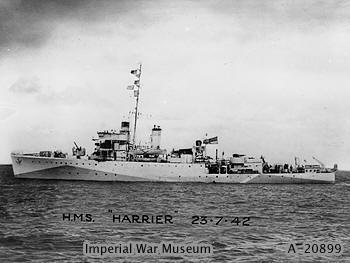
HMS Harrier (IWM A20899)
|
Date of
Arrival |
Place |
Date of
Departure |
Orders,
Remarks etc |
|
1.1.42 |
Scapa |
4.1.42 |
|
|
8.1.42 |
PQ8 (8 ships)
sailed from Hvalfjord escorted by HARRIER (Lt Commander E P Hinton)
and Speedwell (Lt Commander J J Youngs), arriving Murmansk 17/1. The
convoy sailed in the arctic darkness with just a pale daylight at
noon. HARRIER zigzagged ahead while Speedwell brought up the rear.). |
|
17.1.42 |
17/1 Convoy PQ8
was joined by eastern local escort of Hazard and Sharpshooter despite
the thick fog that kept Britomart and Salamander in Kola.
At 1945 on 17/1 Harmatris
was hit by a torpedo from U454 which passed underneath HARRIER.
Speedwell was ordered to drop back and stand by the stationary
Harmatris. An hour later a second torpedo hit Harmatris but failed to
explode, the captain thought he had hit a mine. Speedwell was ordered
alongside to evacuate some of Harmatris’s crew. After much effort a
towing wire was passed but Speedwell was unable to move her as the
starboard anchor had let go when the torpedo struck and stuck fast.
At 2200, as Sharpshooter
had joined the screen, the destroyer Matabele was sent back to
Harmatris. U454 fired another salvo of torpedoes which missed their
target, a tanker, but hit Matabele. Although about 60 of the 200 crew
escaped alive many were killed by the destroyer’s own depth charges
and the cold.
|
| |
On the afternoon of 16th January 1942, all was well with Convoy PQ9,
some bad weather and the occasional 'Ping'. We were not far from the
Kola Inlet and safety. It was my first voyage to North Russia. With
only two Tribal Class destroyers and two fleet sweepers we were not
much protection for the convoy.
My oppo pointed to a strange
cloud formation, "Looks like a destroyer" he said, "that means one
of them will cop it". We all immediately dismissed this as
"Rubbish". In the evening a merchant ship was damaged by a torpedo
and Matabele was soon there to ascertain the damage. She signalled
"Should be able to make harbour".
In the early hours of the
17th my warm cocoon of a hammock was shattered by a large explosion,
together with the ship's alarm bells sounding "Action Stations".
When I reached the upper deck Matabele was broken in two and the
bows and stern were pointing skywards. A few desperate cries were
heard as we stopped to lower our whaler and scrambling nets.
The first man the whaler
approached called out in a calm parade voice, "Don't stop for me -
some of my men are in real trouble over there, pick me up on your
way back". This was a brave act of self-sacrifice, we all knew you
lasted only a couple of minutes in that sea. The unknown hero was
never to be seen again, and we managed to pick up only three from
the sea. The rest would have gone straight down with the ship.
The men that we saved were
smothered in oil fuel and although it was terrible to have it in
your lungs, no doubt it gave them a precious few moments to survive
the savage cold.
It was said that Matabele
had towed the merchant ship for a while, and then kept a close eye
on her and so, when expecting further trouble, switched on her
searchlight to investigate, making a perfect target for the U-boat.
Source: John Eldred, Ordinary Seaman, HMS Harrier - Chris Tye, The
Real Cold War
|
| |
HARRIER raced in to try and pick up survivors. Her task was
difficult and harrowing, for the icy wind bringing the temperature
to 30 degrees below freezing produced a thin swirl of fog which
froze like hoar frost. The decks were by now a mass of ice and
lowering the rescue boat with the ropes and pulleys frozen solid was
a tough and exhausting task. When eventually the boat was lowered
the crew rowed towards the disaster area in the darkness. Here they
found the sea covered with a thick layer of oil fuel spilled out
from the destroyer’s tanks. Steering through the debris, they were
just able to distinguish numbers of men in their life jackets,
floating upright but quite dead. As the crew rowed on they found the
surface littered with men in this gruesome state, victims of the
explosions and the freezing water. Approaching they found the oil so
thick they could hardly move the boat. The oars were dipping into a
mass of thick sludge and getting them nowhere.
Not far away they heard
men calling for help but it was impossible to go further. From
somewhere behind them they heard a chorus of feint shouts. Spurred
on by the cries they went astern and within minutes found three men
together and still alive. They were enveloped in thick oil and the
task of hauling them aboard was formidable for they were much too
weak to help themselves and in their slippery condition it was
difficult to find a handhold.
Eventually the crew
pulled back to the HARRIER and there the survivors were embarked,
which was only accomplished after scrambling nets had been lowered
and heaving lines passed round the chests of the three men who were
by now almost unconscious. By the time they had been carried into
the wardroom for medical attention all three had passed out. An hour
later one was found to be dead but the other two recovered.
(Bill Burras and Ernie Higgins).
Source:
Last Call for HMS Edinburgh – Frank Pearce
|
|
18.1.42 |
The
volunteer crew withdrew from Harmatris to Speedwell and she circled
the freighter all night. At 0600 with both ships alone in the ocean
the crew went back to Harmatris and slipped the anchor chain,
reconnected the tow wire and at 0800 got under way again. They were
now joined by Sharpshooter and Hazard. At noon, a Heinkel He111 made a
half hearted low level attack but was driven off by the AA armaments
of the minesweepers and the DEMS gunners on Harmatris. A second plane
dropped her bombs a mile away.
At about 14.30 a high
pressure steam pipe on Speedwell burst, badly scalding three men and
Youngs signalled for a Soviet tug, which arrived within the hour.
Speedwell left at speed to seek medical assistance for her injured
crew members. Two further tugs arrived and Harmatris got to Murmansk
early on 20/1.
Source:
Extracts from Arctic Convoys by Richard Woodman
|
|
18.1.42 |
Murmansk |
|
PQ8 was brought into the inlet in thick fog without incident,
but it is not intended that this shall be the normal practice. The
Senior Officer 1st MSF led PQ8 to safe anchorage, making use of RDF,
in a most able manner.
Report of SBNO North
Russia |
|
24.1.42 |
At sea |
|
HARRIER and Speedwell
form part of eastern local escort for QP6 (6 ships) from 24/1 until
25/1. Bramble and Hebe joined on 25/1 and remained until 28/1 when the
convoy dispersed. |
|
1.2.42 |
At sea |
4.2.42 |
HMS
HARRIER, Speedwell and Hazard carried out sweeping operations between Svyatol Nos and Cape Gorodetski. No mines swept. |
|
22.2.42 |
|
|
HARRIER,
Hazard and Salamander local eastern escort to PQ11 (13 ships) |
|
1.3.42 |
At sea |
|
HARRIER and Sharpshooter
provide eastern local escort for QP8 from 1st until
dawn on 3rd March as far west as 30°E. The ocean escort
included Hazard (Senior Officer, Escort) and Salamander.
|
|
10.3.42 |
|
|
HMS HARRIER (SO M/F 6),
HMS SPEEDWELL, HMS HUSSAR, HMS SHARPSHOOTER sail pm 10th
March to rendezvous convoy during daylight 11th March.
|
|
11.3.42 |
At sea |
12.3.42 |
HARRIER, Hussar and
Speedwell joined PQ12 (17 ships) as eastern local escort
arriving Murmansk 12/3. Although Tirpitz searched for the convoy, PQ12
arrived unmolested. |
|
21.3.42 |
At sea |
|
Gossamer, Hussar,
HARRIER, Niger and Speedwell provided Eastern local escort for QP9
until 23/3. Ocean escort included Britomart and Sharpshooter.
|
|
28.3.42 |
PQ13
endured the full Arctic repertory of foul weather, and attacks by
enemy ships, submarines and aircraft... The Eastern Local Escort
consisting of the minesweepers Gossamer, HARRIER, Hussar, Speedwell
had left Kola on 28th March to bring the convoy in and look for
survivors and stragglers.
That
evening Trinidad had to stop with salt in the boiler feed water. The
wind died, a full moon and a brilliant aurora lit up Trinidad as a
perfect target. She was only 70 miles from the Kola Inlet. She managed
to get going again and arrived at Kola on 30/3. |
| |
Source: ADM 199/347- Report of the Local Escort
From The Senior Officer, Sixth Minesweeping Flotilla
Date 9th April 1942 No.
F.02/26
To The Commander in Chief, Home Fleet
Convoy PQ13
The following narrative of local escort while meeting
PQ13 is submitted. All times are zone minus three:-
1. Before leaving harbour, it was known that Convoy
PQ13 was widely scattered owing to gales and that S.S. "HARPALION" had
been bombed.
2. H.M.Ships "HARRIER", "GOSSAMER", "SPEEDWELL" and
"HUSSAR" sailed at 1900 through position MU to 37ºE, carrying out an
A/S patrol en route.
3. At 2118 H.M.S."HUSSAR", who was keeping guard on
500 k/cs, reported that the S.S."EMPIRE RANGER" was sinking in
position 72º 13'N 32º 10ºE. As "EMPIRE RANGER" was apparently just
ahead of the convoy and, apart from other escorts in the vicinity of
the convoy, H.M.S."ORIBI" and two Russian destroyers from the Kola
Inlet were already on their way to join the convoy, it was decided
that no useful purpose could be served by detaching one of the
Minesweepers (who at the time were 180 miles away from the position in
which "EMPIRE RANGER" had been torpedoed).
|
|
29.3.42 |
4. Altered course at 0400 to North up longitude 37ºE. At 0500
"SPEEDWELL" was detached with orders to patrol between positions B and
Q and to escort the ships into Kola Inlet. If she met either "RIVER
AFTON" or "EMPIRE COWPER", she was to embark two officers and one
rating, to avoid their being incarcerated by the Russians, as had been
the experience a little before of three officers. It transpired later,
however, that one officer and the rating had sailed in the "EMPIRE
RANGER" and were, presumably, taken prisoner. The officer from "EMPIRE
COWPER" was collected by H.M.S."GOSSAMER" on return to Murmansk.
5. At 0645 a report was received of three German
Destroyers in position 71º 10'N, 31º 30'E at 2200 on 28th.
6. At 0600 and again at 0625, a Junkers 88 was
sighted by "SPEEDWELL" in the vicinity of position B and at 0730 a
Junkers 88 circled "HARRIER", "GOSSAMER" and "HUSSAR".
7. "HARRIER", "GOSSAMER" and "HUSSAR" were to patrol
latitude of 37º E between positions E and U; one of them was to be
detached to escort any unescorted stragglers met, returning to their
patrol after reaching Kola Inlet.
8. At 0632 orders were received from The Senior
British Naval Officer, North Russia that a minesweeper was to be
detached to look for boats from "EMPIRE RANGER" who had reported by
W/T before abandoning ship that they were making for the coast. As
this (Immediate) signal took nearly 12 hours to reach me and as by
that time there were three enemy Destroyers between the position of
sinking and the coast and it was known the H.M.S."ORIBI" and the two
Russian destroyers were near the position, I replied that it was not
proposed to detach a Minesweeper (the Minesweepers being some 120
miles away). At 0825 orders were received from The Senior British
Naval Officer, North Russia to comply with his original signal, and
accordingly "HARRIER" was detailed and in latitude 71º 25' N at 0945
she increased to full speed and steered up the convoy route in the
hope of getting news of "EMPIRE RANGER's" boats from any of the convoy
or escorts met.
9. At 1054 signals were received which indicated a
fight between H.M.Ships "TRINIDAD", "FURY" and "ECLIPSE" and the enemy
Destroyers. Later one enemy Destroyer was reported stopped near the
position where "EMPIRE RANGER" was sunk.
10. At 1045 "HARRIER" encountered ice in latitude
71º 39'N. This proved to be thick brash and "HARRIER" worked round to
the Westward and later to the South-Westward with some difficulty. The
extent of the ice was reported by W/T to The Senior British Naval
Officer, North Russia and to all escorts: also my intention of
proceeding to escort H.M.S."TRINIDAD" (who had reported that she had
been torpedoed and was about 50 miles to the North West of "HARRIER's"
estimated position) and the position, course and speed of
S.S."HARPALION" who was met about that time.
11. H.M.S."HUSSAR", who with H.M.S."GOSSAMER" had
been left to patrol the 37º meridian, sighted a submarine on the
surface at 1046, which was lost sight of shortly afterwards in a snow
squall. At 11.48 "GOSSAMER" obtained an Asdic contact on what was
quite probably the same U-boat. Both ships carried out deliberate
attacks and it appears highly probable the the U-boat was destroyed.
12. At 1335 "GOSSAMER" detached "HUSSAR" to join
"TRINIDAD" and remained in the vicinity of the submarine till dark,
when she resumed patrol south of the ice.
13. H.M.S."SPEEDWELL", patrolling between positions
B and U, had attempted to intercept S.S."HARPALION" at position B but
did not see her. The next morning she left her patrol line in an
endeavour to escort "TRINIDAD", but in the very bad visibility failed
to make contact.
14. At 1625/29th "HARRIER" detected a ship by R.D.F.
at a range of 11,000yards in a heavy snowstorm and shortly afterwards
caught a glimpse of H.M.S."FURY" who was escorting "TRINIDAD".
"HARRIER" was at first stationed on the beam of "TRINIDAD" to check
her speed (estimated then as 11 knots) and her compass. "TRINIDAD" was
then steering from aft and by magnetic compass. As "TRINIDAD''s"
steering appeared a little erratic, "HARRIER" took station ahead of
her to make good her course without zigzagging, while "ORIBI" and
"FURY" screened her on either bow.
15. At 1750 course was altered to 190º to make
Kilbin North Bight. It was arranged that W/T silence should not be
broken to ask for D/F Beacons and that the "HARRIER" should lead
"TRINIDAD" into Kola Inlet by using R.D.F. if necessary.
|
|
30.3.42 |
16. From about 0500 of 30th March the wind increased to Force 8 and
visibility was frequently nil owing to snowstorms. "TRINIDAD's" speed
varied from a maximum of 14 knots to a minimum of 4 during the night.
"FURY", whose R.D.F. was out of action, lost touch at about midnight
and "HARRIER" was unable to detect her by R.D.F. and therefore unable
to lead "TRINIDAD" over to "FURY" as had been ordered by "TRINIDAD".
At about 0500, "TRINIDAD's" speed was 4-5 knots
and for half an hour or so "ORIBI" and "HARRIER" carried out an
endless chain patrol around her.
17. At 0752 "TRINIDAD" broached to and told
"HARRIER" to try to get a wire in to her. By the time "HARRIER" had
turned and got back to her, however, "TRINIDAD" was able to resume her
course. Tugs, all available A/S escorts and fighter cover were asked
for by W/T, as "TRINIDAD" had great difficulty in keeping steam.
18. 0800. Made Kildin Island. Entrance to Kola Inlet
was obscured by snowstorms and "HARRIER" passed in positions obtained
by R.D.F.
19. At 12.00 when inside Kola Inlet "HARRIER" and "ORIBI"
resumed patrol, making for position Q. They were joined at 1500 by
"SPEEDWELL".
"ORIBI" informed me by signal that he had
found "EMPIRE RANGER's" boats at 0840/29th in position 72º 00' N 31º
11'E, showing every sign that the occupants had abandoned them. There
were food, drink and blankets in the boats, so it appears that the men
were picked up by some other ship. As no ship in the convoy or escort
has since reported having picked them up, as German Destroyers were in
the vicinity and as the German wireless has claimed prisoners from a
merchant ship, their fate appears obvious.
20. At 0550 "GOSSAMER" had intercepted the signal
giving "TRINIDAD's" position, course and speed and, having no merchant
ships in sight, altered to the Westward to join her.
21. At 0745the visibility in her vicinity had
cleared to 7 miles and "GOSSAMER" sighted a submarine on the surface
almost 5 miles ahead and three merchant ships at extreme visibility on
her starboard quarter. "GOSSAMER" chased the submarine at full speed
but the submarine drew away and, after half an hour's chase,
"GOSSAMER" shaped a course to join the merchantmen. These ships were
"SCOTTISH AMERICAN", "EFFINGHAM" and "DUNBOYNE".
22. At 1020 "GOSSAMER" received instruction from The
Senior British Naval Officer, North Russia to proceed immediately to
the assistance of "INDUNA", torpedoed in position 70º 55'N 37º 18'E.
Search by daylight and during the night proved ineffective, and patrol
was resumed the next morning.
23. ?045 "HUSSAR", not having succeeded in making
contact with "TRINIDAD", came up with 9 ships of PQ13 and the Whaler
????? escorted by two Russian destroyers (without Asdics) ??????? A/S
trawler (whose A/S was out of action). She escorted ?????? Kola Inlet
and, as the Acting Commodore in "SCOTTISH ??????" had no charts of the
Inlet, led them to Bolshoi Oleni ?????? where they arrived at 2130.
When off Toros Island an ?????? aircraft dropped bombs; there were no
hits. At 2200 ?????? resumed patrol.
24. 1900 "ORIBI" sighted a Whaler ahead, roughly in
Position ?????? "HARRIER" and "SPEEDWELL" closed the Whaler who
proved to be Silja and was wallowing, without fuel in a sea 54. "ORIBI"
????? to the assistance of "RIVER AFTON" who had reported ??????? by a
U-boat.
25. While "HARRIER" was getting "SILJA" in tow,
"SPEEDWELL" patrolled round the two ships to provide an A/S screen and
then ?????? ahead when "HARRIER" with "SILJA" in tow made good ??????
and speed of 5 knots. The wind was then North- ??????, Force 7, almost
astern.
|
|
31.3.42 |
26. "HUSSAR" joined at 0230 and screened astern. Kola Inlet ???? at
08.30 again in very bad visibility owing to snow. "SPEEDWELL" had by
then lost touch, and "HUSSAR" was ordered ???? patrol through
positions Q and B.
27. 10.10 "HARRIER" anchored off the South-East
entrance to ?????? Harbour and got "SILJA" alongside to give her 5
tons ????? "HARRIER" making good an engine defect and repairing ?????.
28. The Captain of the "SILJA" told me that when the
"BALLOT" ?????, her Master told him to take off half the crew. ??????
wisely said he would do so, provided they came by boat, ???? were an
odd collection and the situation had the makings ????? stampede. "SILJA"
later transferred these 40 or so med ????? "INDUNA" who was herself
sunk. Survivors from "INDUNA" ????? (who reached harbour safely) have
since been picked ????? inshore, by Russian patrols.
29. 1230 "SPEEDWELL", who had been patrolling in the
vicinity of the entrance to the Inlet, hove to in sight, and at 1245,
tugs ????? taken over "SILJA", "HARRIER" and "SPEEDWELL" set a course
???? intending to proceed on the reciprocal course to that on ???? the
main body of the convoy had approached the evening ????? it being
known that "GOSSAMER" and "HUSSAR" were ???? between positions Q and B
and the ice limit south of U.
30. 1650 an object was sighted by "SPEEDWELL" (who
was on ????? port bow 7 cables) bearing North. The investigation
?????? to be a red sail. The Master, Chief Officer, two ???? Officers
and thirteen men from the American S.S. "EFFINGHAM" ?????? picked up
by "HARRIER". From them it was learnt that their ????? had been
torpedoed in Position 70º 28'N 35º 44'E at 1100.
This information, and the "HARRIER" and
"SPEEDWELL" were searching for a second boat from the "EFFINGHAM", was
passed by W/T to The Senior British Naval Officer, North Russia. This
signal crossed one from the Senior British Naval Officer, North Russia
ordering all minesweepers to return to harbour and fuel unless in
company with a merchant ship. The search was continued until 0740 of
1st April in generally good conditions of visibility. It was then
abandoned, as I considered that the missing boat, if still afloat,
must be inshore. It was subsequently learned that the second boat was
picked up in the Kola Inlet p.m. 31st and that the 14 occupants are
doing well.
When picked up after 32 hours, the survivors
from the "EFFINGHAM" were, with one exception, in remarkably good
fettle. I was particularly impressed by the bearing of the Chief
Officer and have forwarded a recommendation for him through the Senior
British Naval Officer, North Russia. They had buried five men (having
previously removed their clothes for their own use) not long before we
sighted them, and one of their company, in spite of the unremitting
efforts of Surgeon Lieutenant Ian Mankelly, Royal Naval Volunteer
Reserve and of Henry J Woodward, L.S.B.A. C/MX52544, died two hours
after being brought onboard and was buried at sea that night, a
funeral service having been conducted in the Sick Bay. Most of the
survivors were suffering from frostbite and were a bit restless, and
the Doctor and the L.S.B.A. tended them throughout the night. This is
by no means the first occasion on which this officer and this rating
have worked tirelessly, cheerfully and with undoubted skill under
trying conditions.
|
|
1.4.42 |
31. "GOSSAMER" and "HUSSAR" returned to harbour a.m. and "HARRIER"
and "SPEEDWELL" p.m. 1st April, "NIGER", who had been boiler-cleaning
and repairing Gyro Compass sailed a.m. to search for the Whaler
"SULLA". At 1045 she saw three torpedoes approaching an the surface
from the port quarter. Two were going to pass ahead, but the third
which was expected to pass astern was zigzagging, and the necessary
avoiding action was taken. "NIGER" proceeded at full speed down the
torpedo tracks. a good contact was obtained on the Starboard bow and a
counter attack was made. By a great misfortune, "NIGER'S" Asdic Dome
was leaking slightly, with the result that echoes went woolly within
20º on either bow. Nevertheless the attacks carried out were good and
may have damaged the submarine, since they were made in broad daylight
and the submarine's original firing position was definitely
established at the end of the torpedo tracks which were very plain in
a calm flat sea. A search was carried out for several hours afterwards
and no further contact was obtained.
32. Having failed to find "SULLA", "NIGER" returned
to harbour p.m. 3rd April.
33. Convoy PQ13, the Ocean Escort and the Covering
Force had a strenuous time indeed, competing as they did with gales,
surface, submarine, and air attack, ice and frequent snowstorms
(although the last mentioned were probably an advantage at times), and
the way in which they won through is worthy of admiration.
34. At the same time I submit that, to a much lesser
degree and for a much shorter period, the Local Escort had a non-stop
performance and I would like to pay tribute to the way in which
Officers and men of H.M.Ships "HARRIER", "NIGER", "GOSSAMER",
"SPEEDWELL" AND "HUSSAR" carried out their duties on this occasion.
The receipt of the following signal kindly sent by The Senior British
Naval Officer, North Russia on return to harbour was greatly
appreciated by all ships:-
M.S.6
From S.B.N.O., N.R.
I should like Commanding Officers of all Minesweepers
to know that I fully appreciate the good work in the difficult
conditions in the past few days searching, escorting, and hunting
under the nose of the enemy sea and air forces. It does everyone, but
especially the Engine room department, great credit that all ships
have been ready for service whenever called upon and I am sure that
valuable lives and ships have been saved by the good work
performed.
1742A/1
Commander
Senior Officer, Sixth Minesweeping Flotilla
|
|
Extract from ADM 199/1104 Report of SBNO North Russia
March 1942
I
wish to pay tribute to the recent work of the Minesweeping Flotilla,
consisting of HMS HARRIER (Senior Officer), Niger, Gossamer, Speedwell
and Hussar, under the command of Commander E P Hinton, DSO, MVC,
Senior Officer, 6th Minesweeping Flotilla. These ships have been
escorting QP and PQ Convoys in most severe weather conditions and
expected every form of attack be the enemy at distances up to 300
miles from the base. They have little rest except when cleaning
boilers, and can seldom berth alongside or obtain relaxation. Their
work, especially when meeting convoy PQ13, has been extremely well
done and reflects credit on all concerned.
Signed N Bevan
Rear Admiral, Senior British Naval Officer, North Russia
Polyarnoe, 1942
|
|
Source: ADM 1/14713
Request for payment of climate pay to minesweepers serving in North
Russian waters.
From: The Senior Officer, Sixth
Minesweeping Flotilla
Date: 3rd
May 1942
To: The Rear
Admiral (Destroyers), Home Fleet
Copy to: The Senior Officer, First
Minesweeping Flotilla
Hard Lying Money
1.
It is submitted that in view of the uncomfortable and
unhealthy living conditions which are experienced in HM Ships of the
Sixth Minesweeping Flotilla, consideration may be given to the
granting, as a permanent measure, of Hard Lying Money at the full
rate for these ships.
2.
The increase in complement beyond the numbers for
which these ships were originally designed, by the addition of
specialist ratings for Asdic operation and in some cases for RDF,
has led to a condition in the messes of extreme overcrowding. It is
now impossible in HMS HARRIER for instance, for all the members of
the same messes to sit down to a meal together, and a system of
feeding in relays is the only alternative to a proportion of the
ratings eating their meals standing up or in corners, owing to lack
of table space. In addition, there is room only for 75% of the
ship’s company to sling their hammocks; for the remainder the only
spaces available are benches and tables, and this is a serious
disadvantage at sea in a ship which is naturally ‘lively’.
3.
The discomfort of this congestion are not mitigated
by the considerable ‘sweating’ on the mess decks when ships are at
sea. Upper deck ratings have regularly come off watch during the
winter with extremely cold hands, faces and feet into a tepid and
humid atmosphere and the water drips steadily onto their hammocks,
bedding and gear and on to the mess decks.
4.
These conditions are aggravated while the Flotilla is
employed in North Russia, in the case of some ships for over three
months at a stretch. Although ships have first been fitted out for
Arctic service and the warm clothing supplied has been excellent,
conditions in North Russia have been very severe; apart from an
occasional visit to a cinema and a little skiing, the amenities
ashore have been virtually non-existent with the result that ship’s
companies have been thrown almost entirely upon their own resources
to amuse themselves on board.
5.
In spite of this, the general standard of behaviour
has been very high and the normal atmosphere of cheerfulness has not
deteriorated; this it is submitted is all the more reason why
favourable consideration should be given to the matter.
6.
It is understood that similar conditions obtain in HM
Ships of the First Minesweeping Flotilla.
(Signed) E P HINTON
Commander
Senior Officer,
Sixth Minesweeping Flotilla
|
|
10.4.42 |
HARRIER, Hussar and
Gossamer formed part of the Eastern local escort for QP10 (16
ships) as far as 30°E on 12/4. Speedwell was part of the Ocean escort.
The convoy was heavily attacked by aircraft and submarines during the
first few days. |
|
18.4.42 |
Niger, Hussar, Gossamer
and HARRIER joined PQ14 as eastern local escort and a strong
gale from the north-west sprang up. The convoy arrived Murmansk 19/4
where there were persistent air attacks. |
|
28.4.42 |
Niger, Hussar, Gossamer
and HARRIER joined QP11 (13 ships) from Murmansk as eastern
local escort until 29/4. They escorted the convoy for the first 300
miles and then returned to Murmansk. |
|
|
Murmansk |
29.4.42 |
Intend to sail HARRIER
from Scapa with QP12. HARRIER due for refit.
23/5 Arrangements have
been made for refit of HARRIER to be carried out by Humber Shipwright
Co, Hull |
|
30.4.42 |
On the evening of 30/4 HARRIER had just completed re-fuelling from a
tanker in the Kola Inlet, when a signal was received informing HARRIER
that Edinburgh had been torpedoed by a U-boat.
Source:
http://www.bbc.co.uk/dna/ww2/A2076518
HMS EDINBURGH
By
Brodnax Moore
-
As published in Warship World Vol 3 No8
Autumn 1990
(This story was written by Brodnax Moore’s father David Moore,
Navigating Officer on board HMS HARRIER)
In the minesweepers
our expectation of a warm night in harbour rapidly disappeared as we
were ordered to proceed to sea again at full speed to find and assist
the stricken cruiser. Our captain in the HARRIER, Commander Eric
Hinton, took all this in his stride. He was a fine seaman, expert in
ship handling. Beneath his unassuming and humorous manner, there was
an irreducible core of courage. The minesweepers were never intended
to engage enemy surface ships, but we ail knew that our Captain would
never entertain the thought of running away, even from a German
battleship. My job as Flotilla Navigating Officer was not only to
navigate HARRIER and the sweepers under our command, but to act
generally as the Captain's staff officer in organising any operations
on which our flotilla was engaged.
At 2018 on 30 April, four hours after the Edinburgh had been struck,
we passed outwards from Kola Inlet and began to retrace our course
along the convoy’s track towards Edinburgh's reported position, which
we naturally assumed might in the circumstances be considerably in
error.
|
|
1.5.42 |
By midday on 1
May we were near this position, still searching to the northward with
Gossamer and Niger spread out to the westward to obtain the maximum
width of radar coverage. Hussar was following somewhere astern
escorting a Russian tug to the scene. That evening we ran into the
edge of the ice pack and were forced to turn back to the south. In
doing so we spread our search line to the eastward and by great good
luck we sighted Hussar soon after midnight (it was twilight all night)
and she told us that she had just found Edinburgh. Visibility was now
varying from about one to five miles because of continual snowstorms. [Moore]
Following the
torpedoing of HMS Edinburgh by U456, Niger, Hussar, Gossamer and
HARRIER were sent to reinforce the protective screen of destroyers
while the Russian tug Rubin took her in tow. Just before midnight
with the sun touching the horizon and immediately rising again, the
minesweepers hove into sight. It was found that the tug could not
tow the big ship on her own, so two tows were secured. Rubin on the
port and Gossamer on the port quarter. Even so, they could only make
2 knots. Edinburgh signalled to the minesweepers that ...'in the
event of attack by German destroyers...(they)...are to act
independently, retiring under smoke screens as necessary'.
|
|
2.5.42 |
By 0530
with the destroyers Forester and Foresight on either beam and
HARRIER, Niger and Hussar astern, Edinburgh proceeded steadily.
Intermittent snow showers varied the visibility from two to eight
miles.
At 0627
Hussar, on Edinburgh’s starboard quarter, came under fire from three
German destroyers trying to close through the fog on Edinburgh.
Hussar took up the challenge with a spirited and gallant resistance
to the enemy. She immediately opened fire with her 4 inch gun. Fire
was returned immediately, straddling the tiny sweeper which,
outgunned and outmanoeuvred, fell back towards the two British
destroyers.
Immediately HARRIER and the two destroyers swung round and headed
towards the gun flashes.
Moore:
I was half asleep in the charthouse when I heard a shout from
Lieutenant Holgate, who was our Officer-of-the-Watch, to come up to
the Bridge immediately. Going up the ladder I was thinking 'My god,
this is it'- expecting to see the German battleship Tirpitz, which was
stationed in Northern Norway and might well have been sent to finish
off the damaged British cruiser. In fact it was a German Z-class
destroyer, and her initial salvoes were straddling Hussar, who, like
HARRIER, was between Edinburgh and the German attackers. The time was
0627.
Admiral Bonham-Carter had signalled the Senior Officer 6th Minesweeping
Flotilla previously that, in the event of meeting enemy surface
forces, the sweepers were to retire under a smoke screen. Either we
never received this signal or Cdr Hinton kept it to himself and chose
to ignore it. At any rate, he immediately turned HARRIER straight
towards the German destroyer, increased to our full speed of 14 knots
and opened fire with our single 4 in gun, We obtained one range of the
destroyer of four miles, but our radar then went out of action with
the vibration of the gunfire. Soon three German destroyers came in
sight intermittently, dodging in and out of the snowstorms, and making
smoke that increased the haze. Edinburgh opened fire with the three 6
inch guns in her "B" turret, which was practically the only one of her
four turrets still able to fire. Foresight and Forester came dashing
over from the other side of the flagship and began to engage the
Germans, who kept their distance at four or five miles and refrained
from approaching any closer.
Seeing gun-flashes coming from five separate directions, the Germans
probably imagined that they were confronting a superior force. Each of
these heavy destroyers was armed (we subsequently discovered) with
five 5.9 in guns in addition to torpedoes, so had they pressed in they
might easily have sunk every ship in our force. However, HARRIER and
the other 'fleet' minesweepers looked not unlike destroyers when seen
end-on, so probably the Captain's action in heading straight for the
enemy had saved our lives.
Minutes later a
4-gun salvo of shells fell 500 yards from us, another straddled our
forecastle and then another fell at the correct range just astern, but
fortunately we were not hit. Hussar was also engaging the enemy. The
action continued, with the Germans disappearing from view from time to
time, until 0652 when we sighted ahead a torpedo, apparently running
on or near the surface in the direction of Edinburgh.
These
aggressive tactics by the destroyers and 3 minesweepers kept them at
bay. Edinburgh ordered Gossamer to cast off and, steaming in circles
out of control, opened fire, hitting one of the German ships.
Gossamer and HARRIER closed in on Hussar and Edinburgh, their Asdics
searching for submarines. Unfortunately at 0730 a German torpedo
attack on one of the British destroyers missed but went on to hit
Edinburgh. With both of the destroyers badly damaged, time and again
the minesweepers darted forward firing their guns. Admiral Bonham
Carter described the minesweepers actions as ‘like three young
terriers, going in and firing when they could’. Almost unbelievably
the minesweepers’ valiant action in the cloud and flame of battle
led the enemy to suppose they were destroyers arriving to supplement
the British force and probably restrained them from mounting further
attacks. In reality there was nothing but the small group of
minesweepers to stop the Germans from annihilating every British
ship opposing them.
Edinburgh
was listing at 17 degrees and starting to settle. With Hussar making
a smoke screen, Gossamer was ordered along the starboard side to
take off the wounded and merchant navy personnel being taken home.
The transfer of the wounded from a sloping deck onto the
minesweeper’s deck 12 feet below was a difficult task. The
passengers included many Poles released from Russian prisoner of war
camps, army and RAF instructors, and Czechs who had been interned in
Russia. She embarked 440 officers and men while Edinburgh continued
firing at the German ships.
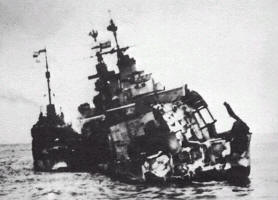
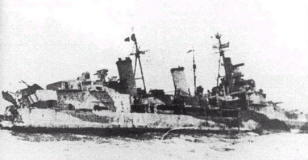
Photos of
HMS HARRIER alongside HMS Edinburgh
At 0800
the order to abandon ship was given and the remaining 350 crew were
transferred to HARRIER on the port side. Captain Hinton and the crew
of HARRIER showed remarkable calmness for the minesweeper was in
danger of being crushed as Edinburgh increased her list. He
signalled to Edinburgh ‘You are leaning on me rather heavily’.
Meanwhile the tug Rubin came rushing in and unfortunately collided
with HARRIER with a resounding crack, causing little damage.
Aboard
both minesweepers the decks were becoming so overcrowded there was
imminent danger of the vessels capsizing. Although the men were
asked to go below to stabilise the vessel a large number were
reluctant to do so. It was understandable in the circumstances,
especially for those who had recently been trapped below decks.
Edinburgh’s First Lieutenant called on the men to follow him and led
the way as far down as it was possible to go. Finally, Rear Admiral
Bonham Carter hoisted his flag on HARRIER.
Moore:
HARRIER had now become the Admiral's flagship, and it was
necessary to hoist the appropriate flag designating a
Rear-Admiral. The nearest we had was a white flag with a red
cross, but two red balls needed to be added to complete it
correctly. I instructed my Yeoman to improvise these with the red
ink from the charthouse, and the flag was duly hoisted.
Admiral Bonham-Carter was a jovial character, but with
exceptionally sound tactical judgment and shrewd common-sense. He
was imperturbable in this misfortune, but was now faced with the
embarrassing fact that the Edinburgh, despite the colossal damage
caused by the three torpedoes, obstinately refused to sink.
HARRIER was ordered to encourage the process and fired twenty 4 in
shells into the ship at point-blank range, but these had little
effect. We then steamed close alongside firing depth charges set
to explode at the shallowest possible depth. One of these actually
rolled down the side of the ship and went off immediately
underneath her, but still without result. Bonham-Carter began to
think of going back on board with a skeleton crew when the
Foresight re-appeared form the murk, having finally driven off the
Germans. She was asked: 'Have you any torpedoes left?' - to which
she replied: 'One'. It so happened that this torpedo had misfired
when Foresight had fired her entire outfit at the enemy.
The
Admiral now ordered the destroyer to sink the Edinburgh with her
remaining torpedo, and we watched her position herself at point-blank range (1500 yards) abeam of the cruiser and saw the torpedo
dive into the sea. There followed the longest two minutes that I
can remember, towards the end of which the Admiral was saying:
'She's missed': but just at this moment the torpedo struck and
exploded, and we witnessed the sad end of this fine cruiser as she
rolled over and sank.
The laden
sweepers, with the Rubin and the damaged destroyers Foresight and
Forester, set course for Kola Inlet.
On the way back Cdr Hinton pointed out with some pride to the
Admiral how we had correctly improvised his flag with the red balls
and hoisted it, to which Stuart Bonham Carter's reply was: 'Two
balls! That's more than I expected to have this afternoon!’
|
|
2.5.42 |
At 1020
Niger, which had been detached in the night to locate and bring in
the two refuelled Russian destroyers, rejoined.
Moore:
We made our
way back to Murmansk, and as we got further from the scene of action
without any more interference from the enemy, our spirits rose. The
sun actually appeared through the clouds, and I was able to make
observations with the sextant. Cdr Honnywill, the admiral's Staff
Navigating Officer, worked out the sights for me, and I still have
his calculations written on the back of the Admiralty signal
informing convoy QP11 that it was being shadowed by a U-boat. These
sun sights enabled us to fix the position of HARRIER fairly
accurately during the afternoon of 2 May, and we made a good
landfall and safely entered the Kola Inlet at 2040 on that day, some
12 hours after the Edinburgh had sunk. Our 'chicks' - the
Niger,
Hussar and Gossamer - were with us. Foresight and Forester also got
back unmolested, but they had both sustained damage and casualties.
Between them and Edinburgh there was a total of 74 killed and 43
wounded in this action, but all the minesweepers had escaped
unscathed. It transpired later that one of the German destroyers had
been scuttled after sustaining heavy damage, and that the other two
had retired at high speed after rescuing the crew.
HARRIER, Gossamer,
Hussar, Niger and the other ships arrived at Kola. Edinburgh’s
survivors were disembarked at Polyarnoe where they were split into
two groups with one group being re-embarked on Gossamer for Vaenga.
The minesweepers stopped at Vaenga to refuel from the Russians.
There was no interpreter and one of Harrier's officers Lt
Christopher McLean was brought a paper to sign as receipt for the
oil. This he did but the Russian official was dissatisfied and by
signs made it clear that he must have a rubber stamp. Very tired and
with somewhat frayed nerves from the last three days' ordeal, McLean
took the only rubber stamp then available bearing the word
'Cancelled' and stamped the receipt. The Russian went away happy.
|
|
Soon after arriving at
Murmansk, HARRIER’s Commanding Officer received the following letter
from the captain of the Russian tug Rubin, which was greatly
appreciated by everyone:
From Commander of Divisions, U S S
R Gunboat Rubin 4th Day of May 1942
Dear Sir,
Soviet seaman has
witness of heroic battle English seaman with predominants powers of
enemy. English seamen did observe their sacred duty before
Fatherland. We are prouding to staunchness and courage of British
seamens – our Allies. I am very sorry what injured your ship by
approach to board for what I must beg pardon.
Commander of Division
Disembarking at
Murmansk, Admiral Bonham Carter sent the following message to the
captain and crew of HARRIER:
...it was inspiring to
see the minesweepers staying on the scene of action and taking every
opportunity of firing at the enemy when visibility permitted. The
manner in which HARRIER and Gossamer were brought alongside the
listing Edinburgh during the action showed a fine feat of seamanship
and I fully confirm the Commanding Officer of Edinburgh’s report of
the way we were treated on board. Never have I seen more kindness
and attention than was given to myself, Captain, officers and men
than by the Captain, officers and ship’s company of HARRIER in which
we left.
A day or two after
arriving in the Kola Inlet, HARRIER entertained Rear Admiral
Bonham-Carter in the small wardroom. Christopher McLean recalls that
at the end of the evening he thanked them very much for their
hospitality and for all the help they had given in the Edinburgh
action. He had no way of reciprocating but wondered whether they had
ever seen an admiral stand on his head. This he proceeded to do much
to the delight and astonishment of his audience.
|
Source: ADM116/4544 Convoys to Russia
March to May 1942
AWARDS
Commander Eric Perceval
Hinton DSO MVO RN Senior Officer 6th MSF HMS HARRIER.
During the
action in which HMS Edinburgh was sunk, Commander Hinton without the
slightest hesitation led his small ships into action against the
more heavily armed attacking force and engaged the enemy wherever
possible. When ordered to bring his ship alongside HMS Edinburgh,
then heavily listing, while the action was still in progress, he
handled his ship with great skill and coolness despite the
possibility of the Edinburgh rolling on the HARRIER at any time.
For outstanding
courage, cheerfulness and devotion to duty while engaging superior
enemy forces.
DSC - Lt Frederic Bradley RNVR
DSM - LSBA (Ty) Henry John Woodward C/MX 52344
'This man, the
only sick berth attendant on board carried out his arduous
duties with skill and determination during and after the
action. Throughout he was of the greatest assistance to his
medical officer, being entirely dependable, and doing much
on his own initiative.'
DSM - AB Edward Swan C/J 109583
DSM - ERA1 Philip Edward Robinson C/M 8008
Mention in Despatches:
Lt John Douglas David Moore RN
Surgeon Lt Ian Miskelly LRCP
Lt Donald Wilcock Holgate MA RNVR
Signalman John William Ferguson C/JX 211219
A/CPO Alfred Edward Roberts C/JX 136574
Leading Steward (Ty) Frank Colman C/LX 26185
Stoker 1 Raymond George Newman C/KX 144418
AB Christopher Douglas Giles C/SS 11813
|
|
21.5.42 |
Eastern Local Escort for QP12 (17 ships) until 23/5 comprised
Bramble, Gossamer, Leda, Seagull and two Russian Destroyers. HARRIER
was part of the Ocean escort arriving Reykjavik 29/5. Although
relatively unmolested, one attack by Ju88’s was deflected by a
Hurricane launched from the CAM ship Empire Morn. One was shot down
but the pilot of the Hurricane, Flying Officer John Kendal, was killed
when his parachute failed to open properly when he abandoned his spent
aircraft. Thick fog prevented any U boats making contact with the
convoy.
|
|
28.5.42 |
Iceland |
31.5.42 |
|
|
3.6.42 |
Scapa |
4.6.42 |
|
|
6.6.42 |
Humber |
25.7.42 |
8/6 Taken in hand for
refit. Completes 21/7
20/7 Anticipate HARRIER
ready to sail 24/7 |
|
26.7.42 |
Scapa |
18.8.42 |
|
|
22.8.42 |
Aberdeen |
29.8.42 |
|
|
29.8.42 |
Scapa |
1.9.42 |
|
|
7.9.42 |
HMS HARRIER (with Gleaner and Sharpshooter) weighed and proceeded out
of Hvalfjord as part of the ocean escort for local portion of PQ18
sailing from Iceland, and was in station on the port side of the
combined convoy by 1900. (Twelve
U-boats were sailed to intercept the convoy and at that time there
were 91 torpedo bombers and 133 high level and dive bombers in
Northern Norway.)
During the night it was appreciated that the three trawlers
detailed were experiencing difficulty in towing the three Motor
Minesweepers although weather conditions were favourable.
During the
night the weather deteriorated and by daylight four of the convoy was
found to have straggled considerably.
|
|
8.9.42 |
At 1100 on 8th September 4 merchant ships,
3 trawlers and 3
motor minesweepers were sighted well astern of the convoy and about 4
miles to the west of the route. The merchant ships had to be
repeatedly chased closer to the North Cape, as they appeared to be in
danger of running into the minefield, the existence of which they
seemed unaware.
The Motor Minesweepers
were now proceeding independently and were clearly much happier than
when in tow. They remained with the convoy throughout, having ample
fuel for the voyage. They withstood some severe weather but no ice was
encountered, which would undoubtedly have hampered them severely.
Source:ADM 199/758
|
|
10.9.42 |
HARRIER and Sharpshooter
depth charged a contact astern of the convoy at midday. |
|
13.9.42 |
First air attacks -
PQ18 attacked by Ju88 bombers to no effect. Two ships sunk by
submarine torpedoes. Then 44 torpedo bombers pressed home their
attack, sinking 8 ships for the loss of 5 aircraft.
Source: Report
of MS6
At 0358 on Sunday 13th
September SS Stalingrad (Russian) and SS Oliver Ellsworthy (USA) were
torpedoed by a U-boat. Survivors were picked up by HM Ships HARRIER,
Sharpshooter and St. Kenan and the three motor minesweepers. At 0945
HMS HARRIER set on fire SS Oliver Ellsworthy by gunfire, after which
15 survivors (Russian) were transferred from MMS 203 to HMS HARRIER.
All the rescue ships rejoined the convoy by about 1100 and survivors
from HMS St Kenan and MMS’s 90 and 212 were transferred to HMRS
Copeland.
At 1515 eight ships were torpedoed by
aircraft. All rescue ships and at least one destroyer proceeded to
pick up survivors. While this work was in progress six HE115 torpedo
planes attempted unsuccessfully to save us the trouble of sinking the
disabled ships. HMS Sharpshooter was ordered to rejoin the convoy at
about 1600 in case of further attack. By 1645, no more survivors could
be found and the trawlers and motor minesweepers were ordered to
rejoin. Three ships, SS John Penn, SS Macbeth and SS Empire Beaumont
were still afloat and a fourth, SS Sukhona, had been lost to sight in
snow storms without being seen to sink. Fire was opened by HMS HARRIER
upon SS John Penn and SS Macbeth but was apparently ineffective. I did
not consider it advisable to use depth charges – of which ships were
already getting short – for sinking ships. The convoy was by now nine
miles ahead, out of sight in snowstorms, and I decided to abandon the
attempt to ensure that all ships sunk in order to escort the trawlers
and Motor Minesweepers back to the convoy. At about 1815 SS John Penn
could be seen settling by the stern but no other ships were visible.
1515 (approx) One He111 torpedo bomber
which had passed through the convoy crashed into sea about 3/4 mile on
HMS Harrier's starboard beam.
At 1845 HMRS Copeland was ordered to
stop and 107 survivors were transferred to her from the Motor
Minesweepers. This was completed by 1935 and all ships rejoined the
convoy just in time for a further attack at 2035. On this occasion
there were no calls on the services of the rescue team.
2038 Aircraft, probably He115 torpedo
bomber seen to crash in flames about three miles on starboard quarter.
|
|
Extract
from The Royal Naval Medical Service Vol II, JLS Coulter
This
experienced organisation of H.M.S. Harrier was particularly
tested in September 1942, when in company with Convoy P.Q.18 to
Archangel. Her Medical Officer recorded:
'Although the convoy had been spotted and shadowed for three days,
all was well until the morning of September 13. Then, at about 0900
the S.Ss. Stalingrad and Oliver Ellsworthy were hit by torpedoes
during a torpedo attack. Although the Stalingrad sank in about four
minutes, 72 survivors were picked up.
'At 1500
eight ships were sunk during a heavy torpedo bomber attack. We
picked up about 100 survivors, most of whom were transferred to the
Rescue Ship Copeland.
'A quiet
few hours followed until the S.S. Athel Templar was torpedoed at
0400 on September 14; 35 survivors were rescued, including two badly
injured cases from the ship's engine room, who were transferred by
Neil‑Robertson stretchers.
'During
the afternoon the S.S. Mary Luchenbach blew up during another
torpedo bomber attack.
'On
September 15 we transferred all our survivors to H.M.S. Scylla, with
the exception of a number of Russians from the Stalingrad.
'Although bombing and U‑boat attacks continued, there were no
further casualties until September 18, when the S.S. Kentucky was
torpedoed and bombed; 33 of her survivors were picked up.'
The report
of this Medical Officer gives an interesting insight into the state
and care of some of these survivors. In the case of the Russian ship
Stalingrad,
some 25 survivors had been in the
sea for as long as forty‑five minutes. They were received in the
Harrier in two batches. The first batch were in fairly good
condition and recovered rapidly.
The second
batch were in poor condition and comprised six women and eleven men.
Among the latter was the ship's third mate who was unconscious and
shocked and had been in the sea wearing only a thin set of
underclothing. Although artificial respiration and oxygen were
administered for 11 hours, the patient died suddenly and his death
was presumed to be due to cardiac failure.
All the
women responded well to treatment. One woman had given birth to a
child two days before. She had been crushed when her ship sank and
had suffered four fractured ribs. Her chest was strapped and she was
made comfortable. During the subsequent seven days the lochia
appeared normal and there was no sign of uterine infection. This
woman's child had been lost with the ship, and this, coupled with
the fractured ribs, resulted in some difficulty with lactation. But
she was relieved by drawing off the excess milk from time to time.
Another
Russian woman was eight months' pregnant, but reached Archangel
without any mishap. This woman gave birth to a living male child 24
hours after landing at Archangel.
Survivors
from the S.S. Oliver Ellsworthy were in good physical and
mental condition, having taken to lifeboats and rafts. One man had
some fractured ribs and another injuries to ankle and spine as a
result of the explosion.
Of the
survivors rescued from the S.S. Athel Templar, two were men
who had been trapped in the ship's engine room, which was flooded
with sea water and oil. Both were very shocked and one was badly
injured. The latter had to be rescued by a rope passed over his oily
body. Unfortunately, in the speed of the moment, this rope slipped
so that the man fell and struck his head. He already had multiple
lacerations, a fractured humerus and a deep gash over the left eye.
Within two hours he had exhibited typical signs of an intra‑cranial
haemorrhage from which he died. The other man was transferred to
H.M.S. Scylla by Neil‑Robertson stretcher.
H.M.S.
Harrier also picked up survivors from S.Ss. Waicosta and
John Penn. These numbered about 50, and were all in good
condition with the exception of one man suffering from a fractured
pelvis involving the right sacro‑iliac joint. A local injection of 6
c.c. of novocaine relieved his pain and he was later transferred to
H.M.S. Scylla by NeilRobertson stretcher. The Captain of the
Waicosta had dived from his ship into the sea as she sank. He
was picked up after ten minutes and, although an oldish man, his
condition was fairly good. But he deteriorated as time passed, and
was in an unfit state when later transferred to H.M.S. Scylla.
|
|
14.9.42 |
Report of MS6
At 0325 on Monday 14th
September, SS Atheltemplar was torpedoed in the engine room. Two
boatloads of her crew were picked up by HMS Sharpshooter while HMS
HARRIER went alongside and embarked the remainder, including two
seriously injured. It was evident that this ship was not sinking.
The Rear Admiral (Destroyers) ordered that if she could steam HMS
Sharpshooter was to tow her to Low Sound. I considered the
possibility of doing this even though she could not steam, but
decided that if this were attempted without an adequate escort
(which would not be available) there was little chance of success
since a further attack was almost certain and there would be an
unjustified risk of losing the towing ship and also both ship’s
companies. I therefore very reluctantly signalled my intention to
sink her and was ordered to do so. At this point HMS Tartar arrived
from a hunt and at my request undertook the destruction of HMS Atheltemplar.
At 1100 on 14th September HMS HARRIER was
ordered alongside HMS Scylla to transfer survivors. HMS Scylla
reduced speed to 8 knots with sea 25 astern and HMS HARRIER was
secured with a spring and a breast as for oiling at sea.
Unfortunately HMS HARRIER’s starboard .5 inch gun came exactly
abreast HMS Scylla’s Oerlikon platform which caused some damage to
former. (This might have been avoided if the spring could have been
veered quickly. It is suggested that it is advisable to load the
spring to the cruiser’s capstan rather than a bollard.)
1416 He111
torpedo bomber which had passed through the convoy crashed into the
sea 1/2 mile on starboard beam. Motor Minesweeper No. 212 states
definitely that this was the aircraft that torpedoed SS Mary
Luckenback.
|
|
|
By this time the Sharpshooter
had come alongside, and was lying on the starboard side. The port
amidship boat from the Atheltemplar pulled alongside with
the Confidential Books in a tin box, and these were handed over to
the Commander of HMS Harrier. The Commander was in touch
with the RAD, who gave instructions that the Atheltemplar
was to be sunk if she could not steam.
HMS Harrier remained
alongside the Atheltemplar to take off the rescue party
with the two injured men. By this time the after boat of the
Atheltemplar was level with the forecastle head of HMS
Harrier, and the crew were transferred. HMS Harrier had
previously passed a towing wire to the Atheltemplar, but
this parted owing to the swell. Eventually a second towing wire
was secured to the stern, which was now only about one foot above
the water. The men in the starboard boat were sent on board HMS
Sharpshooter, as the Harrier was full. I could see that
the Atheltemplar would remain afloat, and I expressed that
opinion to the Commander of HMS Harrier, who discussed the
best way to sink her. Another destroyer came along eventually to
sink the ship, and we left the scene.
HMS Harrier then left to
catch up the convoy, which was about twelve miles ahead, at 0500.
The survivors were instructed to keep below in order to keep the
weight low, and when I came up on deck our ship was on fire. I
understand the destroyer put a depth charge under her, and also
must have put one or two shots into the tanks, as heavy columns of
smoke were rising. At noon we could still see the smoke from her,
and this was the last I saw of my ship. There were about two
hundred survivors on board HMS Harrier, and at 1300 on the
same day a number, including myself, were transferred to the
cruiser Scylla, with the rest of our men from the
Sharpshooter. Just after being transferred another high level
bombing attack developed, but we were kept below decks and saw
nothing of this attack.
We remained on the Scylla
for ten days, and eventually landed at Scapa on 24th
September.
Capt C Ray, SS Atheltemplar
Source: ADM199/2142 and
http://freepages.family.rootsweb.com/~treevecwll/sinking.htm
|
|
14.9.42 |
'The Minesweeper HARRIER will be coming alongside shortly to transfer
survivors. Starboard Watch of Seamen to muster on the forecastle!’ Up
to the forecastle we pounded, while up the lane on the port side
steamed the HARRIER. Heaving lines and hawsers were flaked on deck
ready, and HARRIER began to close the Scylla. With beautiful judgment
and superb seamanship the gap between the two ships began to close,
though our speed had not been slackened. HARRIER looked absurdly small
beside us, and her Captain, bent over the voice pipe at the compass
platform, was on a level with ‘B’ gun. Her decks were crowded with
survivors, and her crew had difficulty in moving around. Closer came
the two ships, and the heaving lines shot across followed by the
hawsers. Closer came the ships ‑ yards, feet, and then inches.
'Over you go!' came the
sharp command from the minesweeper, and the first wave jumped for our
guard rails. We reached out and grabbed them, pulling them over willy‑nilly
to clear the rails for the next wave. The next batch scrambled over,
followed by another, then stopped as the ships parted for a moment.
Slowly they came together again, and the transfer continued. I grabbed
a seaman who was holding on to the guard rail with one hand, the other
hand held
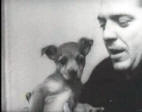 protectively over his coat. 'All right, chum, go
easy,' he complained good‑naturedly. 'Wound?' I enquired, ‘Nah! Look!’ He opened
his jacket and pointed. 'Brought me li'l pup!' There, snuggled against
his rough jersey was a little puppy, innocent, unknowing, but not
forgotten and dearly loved. protectively over his coat. 'All right, chum, go
easy,' he complained good‑naturedly. 'Wound?' I enquired, ‘Nah! Look!’ He opened
his jacket and pointed. 'Brought me li'l pup!' There, snuggled against
his rough jersey was a little puppy, innocent, unknowing, but not
forgotten and dearly loved.
The last survivor scrambled aboard, the
hawsers were let go, and hauled inboard, the HARRIER's bows began to
pay off to port, and with a last wave and a shouted witticism, we
parted company and resumed our stations. The survivors were taken away
to be cared for and there were a hundred extra mouths to be fed by the
Paymaster, extra blankets and clothing to be found for them, and some
needed medical attention.
Source: Flagship to
Murmansk, Robert Hughes |
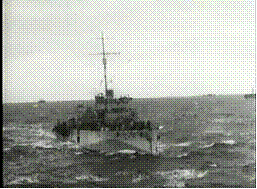 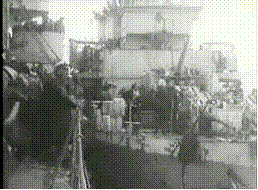
Photos of HMS Harrier transferring
survivors to HMS Scylla 14.9.42
(CLICK
HERE to see video extract -
Windows Media Player required)
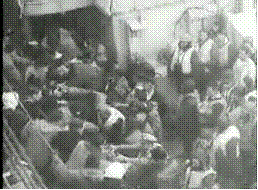 
Source: Naval Video Time Capsules – The Hazards of Russian Convoys
|
|
'Major Casualties‑received from H.M.S. Harrier:
(1) A
Gunner, US. ‑Navy aged 21, ex S.S. Oliver Ellsworthy.
One hour in water.
Exposure.
Injury to Ankle.
Severe pains in loins, with frequency of micturition and slight
pyuria for 24 hours.
Progress satisfactory.
Finally discharged to H.M.H.S. Amarapoora on return to
Scapa Flow.
(2) U.
S. Merchant Seaman, aged 31, ex S.S. John Penn.
Exposure and shock.
Fractured pelvis.
Contused right kidney.
Acute retention with strangury for 48 hours.
Catheterisation showed marked pyuria. After 48 hours condition
clear.
This patient's condition caused some anxiety for a few days, and
progress was somewhat retarded by outbursts of acute hysteria
during the course of subsequent enemy attacks.
Eventual progress was satisfactory.
Discharged to H.M.H.S. Amarapoora on arrival at Scapa
Flow.
(3)
U.S. Engineer, aged 44, ex S.S. Oliver Ellsworthy.
Exposure and shock.
Fractured ribs.
Burns of chest.
Progress satisfactory.
Discharged to H.M.H.S. Amarapoora on arrival at Scapa
Flow.
(4)
British Merchant Navy Engineer, aged 20, ex S.S. Athel
Templar.
Severe exposure.
Severe oil fuel poisoning with haematemesis for 24 hours.
Broncho‑pneumonia.
Condition caused anxiety for some days.
Subsequent progress satisfactory.
Discharged to H.M.H.S. Amarapoora on arrival at Scapa
Flow.'
Extract from Report of Senior
Medical Officer HMS Scylla
as recorded in The Royal Naval Medical Service Vol II, JLS
Coulter
|
|
15.9.42 |
At 0035 on 15th
September, Motor Minesweeper No. 90
who had reported that she was very short of coal for cooking and of
drinking water, came alongside and 5 cwt of coal was transferred and
3 tons of drinking water were then pumped across comfortably with
both ships under way steaming at 9 knots: sea, calm.
A force of about
fifty bombers attacked the convoy in twos and threes between 1235
and 1535, three were shot down without loss to the convoy.
1515 approximately, one He111
torpedo bomber which had passed through the convoy crashed into the
sea about ¾ mile on HMS HARRIER’s
starboard beam.
2038 Aircraft,
probably He115 torpedo bomber seen to crash in flames about three
miles on starboard quarter.
|
|
16.9.42 |
Source:
Report of MS6
One Ju88 torpedo
bomber which had passed through the convoy crashed into the sea and
blew up about 1/4 mile on port beam. No survivors were rescued from
any of the aircraft which had crashed (on 13th, 14th and 18th). In
all cases but that on the 14th HMS Harriers Oerlikons were hitting,
but as these aircraft had already passed through a hail of fire from
the convoy and the other escorts, it is considered that they
represent victories shared by a large number of ships.
At 1530 on Wednesday 16th, on the
departure of the Rear Admiral Destroyers and the covering force, HMS
HARRIER was ordered by the senior officer of the Escort to take up
position M and act as guide of the screen. The duties of Senior
Officer, Rescue Force were turned over to the Commanding Officer,
HMS Sharpshooter with instructions that damaged ships should, if
possible, be brought into Iokana.
It is
snowing hard this morning. We have been spotted by a Dornier and
unless the weather favours us, I guess we will all be standing by.
Source: Diary of Jack Bowman who served on La Malouine. |
|
18.9.42 |
The decks are covered with ice and snow, and it is blowing a gale.
We took on oil from one of the tankers, this was done while under
way. Some of the seamen were brought in with their jaws frozen up.
It is icy-cold in the engine room. I have been so long without a
good meal I don't think I shall be able to eat one now. We passed
the island of Good Hope tonight.
Source:
Diary of Jack Bowman who served on La Malouine
The weather
continued poor with low visibility. Twelve four engined Heinkel 111’s,
lead by Werner Klumper, deployed in line abreast across the rear of
the convoy and were met by the combined fire of the Ulster Queen,
Granyaschi and Sharpshooter as well as the rear merchant ships in each
column. Most of the Heinkels released at 3 – 4,000 yards. Only one
cargo ship, the American vessel Kentucky, was hit. The 55 crew and 14
armed guards abandoned ship but the vessel remained afloat.
HARRIER
proceeded to the van of the screen ordering Sharpshooter to organise
rescue work with Trawlers and the Motor Minesweeping Vessels. The crew
of Kentucky had abandoned the ship and were picked up by the M/M
vessels.
When two miles
astern the Convoy a further torpedo bomber attack developed by 12
aircraft. There was no loss to the convoy. The air escort arrived pm
and were present during daylight hours until arrival at Archangel.
At 1830 on 18th
September, HM Ships Halcyon, Britomart, Salamander and Hazard (local
eastern escort) were sighted off Cape Gorodetski and the following
signals were exchanged:-
TO Halcyon
FROM HARRIER
Do you
consider it necessary for convoy to be swept through channel?
TO HARRIER
FROM Halcyon
Do not
consider it necessary as we have been sweeping for past seven days.
Propose going ahead now or early morning to sweep Dvina approaches for
ground mines. Enemy air minelaying active recently.
TO Malcolm
FROM HARRIER
Halcyon
reports channel clear. In view of this and unsuitable weather propose
cancelling tonight’s sweep. 1844
TO HARRIER
FROM Malcolm
Concur. 1848
TO Malcolm
FROM HARRIER
Halcyon
reports ground minelaying in Dvina approach channel. If you can spare
us from AA duties propose parting company at Pori and proceeding with
all available sweepers to search approach channel before arrival of
convoy. Alternatively detach local sweepers now for this purpose.
TO Halcyon
FROM HARRIER
When detached
proceed as you propose. Have the sweeper marking edge of swept channel
for convoy.
After heading
the convoy into the searched channel off Cape Gorodetski, the four
local minesweepers were detached at 1740 in accordance with HARRIER’s
previous message.
On being asked
whether the Group 1A lights had been requested, HMS Halcyon replied
that the SBNO Archangel had arranged for the lights to conform with
the convoys NTA signal. Out of respect to Russian wishes, however,
these lights were not shown. ( It is submitted that it is impossible
to keep the convoy within the searched channel without shore lights
under the conditions which were found to prevail, namely,
unfamiliarity with the coast, a dark night, low visibility and strong
tides. Radio beacons alone are not considered sufficient for such
accurate navigation. In this connection it may be useful to recall
that Group 1A lights were instituted for use by heavy ships and
convoys at the suggestion of Rear Admiral Wake –Walker after he had
had personal experience with QP2 in October 1941. – Commander A D H
Jay)
Four
minesweepers were anchored at three mile intervals to mark the swept
channel and to act as V/S links. HMS HARRIER anchored close to Fairway
Buoy as a leading mark for the convoy.
|
|
19.9.42 |
At
1850 on 19th September,
HMS HARRIER was forced by a strong
westerly gale to weigh and steam to seaward.
The convoy arrived off
Archangel at 1700 on Saturday 19th but weather conditions
prevented ships proceeding into harbour until Monday 21st
September.
|
|
20.9.42 |
At
0205 on 20th the steering engine failed and HARRIER was
hove to in hand steering. The after ballast tank (32 tons) was already
full to reduce racing. The forepeak (7 tons) and the double bottom
compartments (15 tons) between 57 and 65 stations port and starboard
were now flooded and this made steering appreciably easier. Repairs to
the steering engine were effected by 1250 on 20th
and HMS HARRIER returned
to the convoy in time to organise A/S patrol of Minesweepers.
Three
merchant ships ran aground on the Dvina Bar at the entrance to the
White Sea during an attack by twelve Ju88’s while seeking shelter
during the gale.
|
|
21.9.42 |
At 0845 on 21st
HMS HARRIER proceeded up river piloted by the Master of SS Stalingrad
and landed 24 Russian survivors at Krasny quay.
During the passage of
PQ18 the enemy lost three U-boats and about 40 aircraft but managed to
sink 13 merchant ships. |
|
|
Source: ADM 1/ 12427 Convoy PQ18 to North Russia
AWARDS
T/Surg Lt Geoffrey
Holker MURRAY RNVR - This officer who had only been at sea for two
months supervised most efficiently the care of 152 survivors
including wounded and a large number who required first aid. Mention
in Dispatches
A/CPO Torpedo Coxn
Alfred Edward ROBERTS C/JX 136574 - Largely owing to CPO Roberts'
skill and good seamanship at the wheel of HMS HARRIER, 126
survivors, including two stretcher cases, were successfully
transferred to HMS Scylla while both ships maintained the speed of
the convoy. He showed commendable resource and untiring energy in
organising accommodation, clothing and victualling of 152 survivors.
Mention in Despatches.
Ldg Seaman William
Charles STONELL 17832C - For resolute conduct and good seamanship as
coxswain of rescue boat crew which picked up survivors while enemy
air attack was actually in progress. Mention in Despatches.
A/Ldg Seaman Robert
Desmond HOUGHTON LD/X7832C - For resolute conduct and good
seamanship as coxswain of rescue boat crew which picked up survivors
while enemy air attack was actually in progress. Mention in
Despatches.
Able Seaman Frank
William HAYWARD C/JX 158849 - Able Seaman Hayward set an outstanding
example of good shooting during prolonged air attack. A hit from his
Oerlikon guns caused a fire in an HE111 torpedo carrying aircraft
which was seen to fall into the sea. Mention in Despatches.
Commander A D H JAY DSC. HMS HARRIER was stationed in the rear of the screen until the
entrance to the White Sea was reached, when, due to the Commanding
Officer's knowledge of local conditions, she was stationed ahead of
the convoy so that she could lead it in. HARRIER did invaluable
service in passing information, made a number of most valuable
suggestions, and, when the Local Minesweeping Flotilla joined the
convoy on September 18th, handled it most efficiently.
Captain A N Sacharoff,
Master SS Stalingrad. He volunteered to keep watch in HMS HARRIER as
Liaison with Russian lookouts. His local knowledge was of great
assistance and he piloted HMS HARRIER from Dvina Bar to Archangel.
V G Ermiloff, Chief
Officer SS Stalingrad - requested that survivors from his ship's
company be allowed to do duty in HMS HARRIER, organised them as
extra A/S lookouts and kept watch as Liaison officer with them. Also
acted as signalman to Russian ships.
Captain Lieutenant K A
Egoroff USSR Navy - after being rescued from SS Stalingrad he
voluntarily kept watch as liaison officer with Russian lookouts
detailed from survivors.
Lieutenant (Junior
Grade) Kelly US Navy/SS Oliver Ellsworthy- while aboard HMS HARRIER
this officer volunteered for ship's duties and in cooperation with
the ship's officers organised US Navy Gunners to augment the ship's
cruising watches.
Civilians:
Mrs E A Pusireva ex Soviet Embassy at London. This
lady was rescued by MMS No. 203 after being 45 minutes in very cold
water and oil; she was transferred to HMS HARRIER clad only in a
blanket. Two hours later she was at work (in borrowed clothes)
assisting the medical officer and interpreting for him. She then
took charge of three stewardesses rescued from SS Stalingrad and set
them to work washing up and scrubbing out messdecks. Her conduct was
an example to us all, British and Russian.
|
|
SURVIVORS |
|
Rescue Ship |
Date (Sept) |
Time |
No. Survivors |
Ship of origin |
Disposal |
|
HARRIER |
13th |
0900 |
25 |
Stalingrad (15
transferred from MMS 203) |
1 died
24 Archangel |
|
HARRIER |
13th |
0900 |
126 |
Oliver Ellsworthy |
Scylla |
|
HARRIER |
13th |
1515-1645 |
Waicosta.
John Penn |
Scylla
Scylla |
|
HARRIER |
14th |
0400 |
Athel Templar |
1 died,
remainder Scylla |
|
Sharpshooter |
13th |
0900 |
30 |
Oliver Ellsworthy |
Scylla |
|
Sharpshooter |
13th |
1530 |
33 |
Empire Beaumont |
30 Scylla
5 Archangel for Empire
Bard |
|
Sharpshooter |
14th |
0345 |
35 |
Athel Templar |
Scylla |
|
Sharpshooter |
14th |
1430 |
1 |
Nathaniel Green |
Archangel |
|
Sharpshooter |
15th |
1500 |
1 |
Toilisi (from Fury) |
Archangel |
|
MMS 90 |
13th |
0822 |
37 |
Stalingrad |
Copeland |
|
MMS 90 |
13th |
0900 |
6 |
Oliver Ellsworthy |
Copeland |
|
MMS 90 |
13th |
1530 |
46 |
Sukhona and Macbeth |
Copeland |
|
MMS 90 |
18th |
1110 |
21 |
Kentucky |
Archangel |
|
MMS 203 |
13th |
0900 |
15 |
Stalingrad |
HARRIER |
|
MMS 203 |
13th |
1530 |
47 |
Afrikander |
46 Copeland
1 Archangel |
|
MMS 203 |
18th |
1110 |
33 |
Kentucky |
Archangel |
|
MMS 212 |
13th |
0900 |
10 |
Stalingrad |
Copeland |
|
MMS 212 |
13th |
1500 |
14 |
Oregonian |
Copeland |
|
|
Source:
Extract from The Royal Naval Medical Service Vol II, JLS Coulter
By this
stage of the war most men‑of‑war had themselves evolved an
organisation on board for the rescue, resuscitation and after‑care
of survivors from other ships.
In January
1942, H.M.S. Harrier rescued 16 survivors from a lifeboat
belonging to the S.S. Effingham (U.S.A.).
On February 3, the
same ship took on board 17 survivors from the torpedoed S.S.
Greylock;58 other survivors from this ship were picked up by the
S.Ss. Northern Wave, Oxlip and Lady Madeline. The air
temperature on these occasions was 15° F., and sea temperature 36°
F.
Between
August 13 and 15, H.M.S. Sharpshooter, acting as a rescue
ship, picked up 101 survivors, of whom 20 were suffering from
immersion.
Before the
end of 1942, H.M.S. Harrier had had many such experiences.
The organisation on board this ship was based on the principle which
aimed at the least movement of injured survivors. The ship's
wardroom and the captain's cabin were used for resuscitation because
of their easy access. The sick bay was used for walking casualties
and for nursing those badly injured. The positions chosen were such
that, having been dealt with and resuscitated, survivors could pass
to the mess decks where they would be fed and warmed.
It is of
interest to note in the record of this ship's organisation that no
attempt was made to arrange sleeping accommodation for uninjured
survivors. This was a deliberate policy, it being considered
essential that the ship's company, upon whom the lives of these
survivors depended, should retain their own customary sleeping
billets for such short periods in which they could enjoy rest.
Uninjured survivors had to make use of what space they could find
elsewhere on board.
|
|
? |
Archangel |
19.10.42 |
|
|
21.10.42 |
Kola Inlet |
23.10.42 |
|
|
26.10.42 |
Archangel |
? |
|
|
Source: ADM 1/14347 Sixth MSF. Service in Northern Waters 1942.
Nine awards to personnel of HMS HARRIER and HMS Gleaner.
Towards the end of 1942, HMS HARRIER and HMS Gleaner gained unique
experience when they were placed under Russian command operating from
Iokanka. The following extracts are summarised from the Report.
From: Commander
A D S Jay, Senior Officer, Sixth Minesweeping Flotilla. 31st December
1942
Report of
Proceedings from 4th November to 12th December
On 4th November
HM Ships HARRIER and Gleaner sailed from Archangel and at 1330 on the
5th arrived at Iokanka to take part in Operation F.B.. HM Ships Cape
Aragona, Cape Mariato and St Kenan were already at sea acting as
rescue ships along the route of the merchant ships. The two
minesweepers were to act under the orders of Rear Admiral Abramov,
commanding Iokanka base, as part of the force escorting incoming
ships.
HM Ships HARRIER
and Gleaner were directed to meet John Walker. They sailed at 1730 on
the 5th but did not sight John Walker either on the 6th or 7th.
Russian PE 111's and MDR 111's were expected but the only aircraft
sighted was an HE 111 at 1315 on the 6th.
HM Ships HARRIER
and Gleaner entered Iokanka at daylight on 8th and fuelled from the
oiler Jeliabov at the rate of 40 tons per hour. Information was
exchanged with the Russian staff, among that supplied to them was: (a)
a list of casualties contained in signal from the SBNO Archangel timed
1330/6th, (b) distress message from Chulmleigh read on 78 k/cs at
0708/6th, (c) distress message from Hugh Williamson read on 300 k/cs
at 1248/7th.
On the 9th the
Minesweepers were requested to search for a ship from whom a distress
message had been received. Both ships proceeded at 1545 with the
rescue tug Skval. Sokrushitelni proceeded later. At 2205 Hugh
Williamson was located and escorted to Dvina Bar by HMS Gleaner. HMS
HARRIER parted company at Terski Orlov and returned to Iokanka. In
reply to signals Hugh Williamson stated that she had made no distress
message but had 'reported a doubtful aircraft'. She also reported that
her compasses were 'in bad shape'. When located she was proceeding at
slow speed to wait for daylight before making a landfall.
On the forenoon
of 10th November, wind force 10 from SSW was experienced in Iokanka.
HMS HARRIER's anchors held with 5 and 4 shackles out and the trawlers
did not drag seriously. Razumni and Sokrushitelni, after weighing and
re-anchoring several times proceeded to sea for safety.
At 0900/13th HM
Ships HARRIER and Gleaner sailed to meet Empire Scott and Empire Sky
whose 'farthest on' position was estimated as position F at 1200/14th.
A position 35 miles south of F was reached at 1030/14th. From then
until 1800/16th a patrol along the route was maintained steering
northward in daylight and good visibility and zigzagging southward in
dark or bad visibility, covering a width of 25 miles with a speed of
advance of 7 knots. On the afternoon of 16th the wind freshened to a
gale from North-East, raising a heavy sea. At 1800 I estimated that we
were north of the merchant ships' 'farthest north' position and in
view of this and the weather decided to steer for Kharlov and thence
along the route to Kola.
At Kola
information was received that two merchant ships had been sighted by
shore lookout between Iokanka and Kharlov and the minesweepers
proceeded at 1300/17th in search for them. Empire Scott was duly met
but as she was already being escorted by Rubin and Sapfir, the search
was continued for the second ship. She was also located but proved to
be Russian and HM Ships HARRIER and Gleaner entered Iokanka at
0900/18th. Fuelling from Jeliabov was accomplished with some
difficulty on account of the swell and would probably have been
impossible the previous day.
On the night of
19th to 20th November in a final effort to locate Empire Sky, HMS
HARRIER patrolled the coast between Svyatoi Nos and Kharlov Island,
HMS Gleaner (while taking an injured man to hospital at Vaenga)
covered the section of the route west of Kharlov.
At 2000/20th HMS
Cape Argona sailed to rendezvous with Meanticut 9 miles north of
Svyatoi Nos at 2200. Her instructions from me were that if Meanticut
should not me sighted by 0100/21st HMS Cape Argona should proceed
along the route. If 'Not met' during daylight of 21st Cape Argona was
to enter Kola Inlet, report the general state of trawlers and bring
back any available stores and provisions. During the night information
was received that Meanticut was more than four hours late and was
being brought into Iokanka by the Russian escorting trawler. HMS Cape
Argona was recalled but was unable to comply because she was hove to
in a north-easterly gale. During this gale, with the temperature
between 13º and 30º F., ice formed to a thickness of 2 feet on her
decks abreast the engine room casing.
On 30th November
the Minesweepers reached Iokanka after sweeping two Russian ships into
the White Sea. By now their boiler hours were 60% above the number
allowed and urgent arrangements were made for some boiler cleaning to
be carried out. Because of the bad weather at Iokanka it was
considered essential for safety to have steam for full speed available
at short notice.
On 5th December
attempts were made by HARRIER to meet two Russian ice breakers and
sweep them through the White Sea. At 0430 two ships were sighted but
when challenged with first red then white Aldis lamp, no reply was
received. Because they were 15 miles out of position and enemy
destroyers had twice previously been encountered in this vicinity it
was decided that to close further was an unjustifiable risk for a
single minesweeper and HARRIER was ordered to return to Iokanka.
Three groups of
merchant ships including the Hugh Williamson, John Walker, Richard
Alvey, Campfire and Empire Galliard were escorted, the merchant ships,
owing to their unreliable compasses and lack of local knowledge
requested the Senior Officer of the escort to act as a guide. The
following signals give a good indication of the methods adopted:
TO: MS6
FROM: Empire Galliard
Master cannot
rely on his compass
TO: Empire
Galliard FROM: HARRIER
Keep directly
astern of me. I will adjust my speed to yours. Reduce a little to
let Campfire catch up.
TO:
Campfire FROM: HARRIER
What is your
maximum continuous speed?
TO:
HARRIER FROM: Campfire
10 1/2 knots
TO:
Campfire FROM: HARRIER
Then I beg
you not to be so suicidal as to get astern of station again.
TO:
MS6 FROM: HMS Cape Aragona
Both these
merchantmen's compasses are unreliable, course needs to be checked
after alteration. I had to lead them up from the Bar.
TO: Cape
Aragona FROM: HARRIER
Thank you; I
am taking guide.
TO: Hugh
Williamson FROM: HARRIER
Keep in my
wake. After dark I will burn dim light which only shows directly
astern. Maintain 9 knots.
TO: Richard
Alvey FROM: HARRIER
Speed 9
knots. Keep closed up.
TO: John
Walker FROM: HARRIER
Am
endeavouring to lead you clear of suspected minefield. Please
follow me more closely.
TO:
HARRIER FROM: Hugh Williamson
Many thanks
for splendid assistance.
TO: Hugh
Williamson FROM: HARRIER
All part of
Minesweepers' job. Thanks for following so well.
TO:
HARRIER FROM: Richard Alvey
Thanks for
grand escort.
--------------------
Following this period in Northern Waters, Commander
Jay, Lt Commander Hewitt, Captain of HMS Gleaner and seven other
members of Gleaner's crew received awards.
'I would like to draw your attention to the excellent
service carried out by HM Ships HARRIER and Gleaner, acting under
the Senior Office 6th MSF (now 1st MSF) - Commander ADH Jay (HMS
HARRIER) during the time they have been in North Russian waters
recently'.
'Their work has been strenuous, weather conditions
have been bad, and the usual hazards inherent to minesweeping have
been encountered. Both ships have been intelligently handled and
have earned much praise and respect from the Russian naval staff.'
Rear
Admiral Douglas Fisher
|
|