






|
|
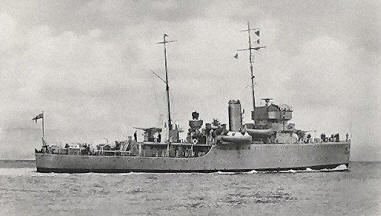
HMS Leda
(www.battleships-cruisers.co.uk)
|
Date of Arrival |
Place |
Date of Departure |
Orders, Remarks etc |
|
14.1.42 |
Scapa |
17.1.42 |
|
|
18.1.42 |
Rosyth |
? |
|
|
19.1.42 |
Port Edgar |
17.4.42 |
9/2 From A S Rosyth: LEDA
taken in hand for refit and fitting out for cold climates. Provisional
completion date end of March 1942
6/4 From D of D: LEDA
completes 13/4 ex trials |
|
18.4.42 |
Scapa |
23.4.42 |
|
|
25.4.42 |
Iceland |
26.4.42 |
|
|
26.4.42 |
PQ15 sailed from
Reykjavik on 26/4 with Bramble, LEDA and Seagull as part escort. |
|
2.5.42 |
Heavy escort left the
convoy and Capt J Crombie of HMS Bramble became senior officer of the
escort.
CLICK HERE for Bramble's Report on
Convoy PQ15
At 2009 Seagull (Lt
Commander Pollock) with the destroyer St Albans attacked and brought
to the surface a submarine later identified as the out of position
Polish submarine Jastrzab. She was sunk by gunfire. |
|
3.5.42 |
At 0127 convoy PQ15
was attacked by six He111’s at low level, sinking 3 merchant ships
with their torpedoes. Three aircraft were shot down. 137 survivors
were picked up.
At 0142 LEDA
carried out an attack on a submarine (Click
here for Report)
At 2230 the convoy was
bombed by Ju88’s scoring one near miss for the loss of one aircraft.
|
|
4.5.42 |
In the evening a
south-easterly gale blew up off the Russian mainland, filling the air
with snow clouds and concealing the convoy. |
|
5.5.42 |
The convoy arrived Kola
Inlet at 2100.
MESSAGE 2300/B 5th May
1942 From SO 1st M S Flotilla
PQ15 arrived
Murmansk. Regret to report loss of Botavon, Jutland, Cape Corso as a
result of attack by six torpedo aircraft at 2327 May 2nd in position
73N, 19.40E. Attack carried out in good conditions and aircraft
appeared to be led in well by leader who may not have carried
torpedo. Indications that shadowing submarine may have surfaced and
fired torpedoes at same time. One aircraft destroyed and possibly
one other. 136 survivors including Commodore. Convoy bombed at 2230
May 3rd in position 73N, 31.51E. Minor damage from near miss to Cape
Palliser only. One Junkers 88 shot down. Attack badly carried out
and hampered by low cloud. Convoy continuously shadowed by one or
more aircraft and or one or more submarines to 36E. Submarines
driven off successfully by screening force forcing them to dive and
firing depth charges in vicinity.
|
|
21.5.42 |
At sea |
23.5.42 |
Eastern
Local Escort for QP12 (17 ships) comprised Bramble, Gossamer,
LEDA, Seagull and two Russian Destroyers. Harrier was part of the
ocean escort arriving Reykjavik 29/5 without incident. |
|
29.5.42 |
On the
evening of the 29th, 140 miles NE of the Kola Inlet,
Captain Crombie commanding the 1st MSF based at Kola joined
PQ16 in HMS Bramble, together with LEDA, Seagull, Niger, Hussar
and Gossamer. The convoy divided and at 2330 Crombie’s section,
escorting six of the merchant ships to Archangel, was attacked by 15
Ju88’s while 18 attacked the Murmansk-bound ships. |
|
30.5.42 |
Crombie’s division,
proceeding in line ahead and led by the Empire Elgar, arrived at the
estuary of the Dvina on 30/5 where it met the ice breaker Stalin. They
began a passage through the ice lasting 40 hours. Confined to the
narrow lead cut by the Stalin, they were attacked by Ju87 Stukas in a
noisy but useless attack. This section of PQ16 passed
Archangel and secured alongside at Bakarista, a new wharf two miles
upstream. |
Commander Onslow, Senior Officer close escort reported that four
fifths of the convoy had got through.... ‘due to the gallantry,
efficiency and tireless zeal of the officers and men of the escorts
and to the remarkable courage and determination of those of the
merchant vessels. No praise can be too high for either’.
|
|
31.5.42 |
Kola Inlet |
? |
|
|
14.6.42 |
Attacked by six JU87's off
Mishkov Point; five near misses caused some minor damage |
|
|
REPORT OF ATTACK BY AIRCRAFT
|
Name
of Ship: |
HMS
Leda |
Position: |
Mishukoz
Pt. brg.185º 4 cables |
|
Date
of Attack: |
14.6.42 |
Course |
Ship at
anchor |
|
Weather: |
Very Fine |
Wind:
|
N.E. 0-1 |
|
Cloud:
|
Nil |
Visibility: |
Very good |
|
PARTICULARS
OF ATTACK |
|
| |
|
|
Form of
Attack (HLB, LLB, D/B or torpedo) |
D/B |
|
Number of
aircraft attacking |
Six
|
|
Type of
aircraft |
Ju.87s. |
|
Direction(s)
of attack relative to ship's head and sun |
30º on
starboard bow. Out of sun |
|
Number of
(a) bombs or (b) torpedoes dropped |
One large
type )
Four small type ) |
Each
aircraft |
|
Approximate
height of release of bombs |
1,200 feet |
Estimated
size of bombs, and Type.
Nature of fuze (Impact or Delay) |
Large Type
500 lbs ) There appeared to be a
Small Type 100 lbs ) slight D/A fuze. |
|
Approximate
position in which bombs fell |
One port
side of bow, remainder down Std. side and astern. App.
10' - 50' |
|
Number of
(a) hits (b) near misses (within 50') |
(a) Nil
(b) Approximately 4. |
|
Damage to
ship (briefly) |
Shearing
devices of rigid/resilient bearing on both L. P.
Turbines sheared. |
|
Casualties
to personnel |
Nil |
| |
|
|
PARTICULARS
OF DEFENCE |
|
Gunfire
used - Long Range Controlled
Barrage Fire |
4" Mark V.
1 Round |
|
Close Range weapons |
- |
|
Avoiding
action taken |
- |
|
Damage or
casualties to aircraft and evidence in support thereof |
No evidence
to support damage to A/C |
| |
|
|
GENERAL
REMARKS, TO INCLUDE ANY POINTS OF INTEREST |
The A/C were heard bearing on 149º and a few seconds
later were seen diving on the ship almost directly out
of the sun at an angle of sight about ..., height
approximately 3000'. The time between aircraft being
sighted and the first bomb hitting the water was about
four seconds.
The four
inch gun which had been ordered to be kept layed and
trained into the sun was fired within two seconds,
before short range weapons could open fire the ship was
enveloped in a quantity of water and spray blotting out
the diving aircraft.
The 25'
Motor Boat lying astern had bottom on starboard side
stove in, but considering how near bombs fell remarkably
few splinters came into the ship, this is explained by
slight delay action of bombs.
At the
time friendly fighters were in the vicinity and shore
batteries opened fire as the aircraft were diving at the
ship.
(Signed)
COMMANDER IN COMMAND
HMS Leda
14th June 1942 |
|
|
|
The soviet icebreakers
Krassin and Montcalm were escorted to Archangel by HMS Bramble, LEDA,
Hazard and Seagull. HMS Intrepid and Garland were sailed later to act
as cover against possible surface attack. The whole force arrived at
Archangel on 21st June. |
|
21.6.42 |
Archangel |
? |
|
|
26.6.42 |
At sea |
|
Bramble, Hazard, LEDA and
Seagull formed part of the local escort for QP13 (36 ships)
from 26/6 to 28/6. Ocean escort included Niger (to 5/7 when she sank)
and Hussar (to 7/7). Thick weather meant the convoy was not attacked. |
|
29.6.42 |
Hazard and LEDA escort
the tanker Hopemount from Murmansk to Archangel. |
|
1.7.42 |
Archangel |
? |
|
|
11.7.42 |
Hazard and
LEDA met Britomart, Halcyon, Samuel Chase, Ocean Freedom, Lotus, Lord
Middleton and Northern Gem and took the weary survivors of PQ17
in to Archangel. |
|
22.7.42 |
Bramble, Hazard, LEDA and
four other ships met some more of the surviving ships from PQ17
and escorted them into Archangel, arriving on the evening of 24/7.
|
|
|
On the subject of morale, the Medical Officer of H.M.S. Leda
recorded:
'It has
been rather interesting to observe the reactions of people to the
abnormal stress and strain which action in this climate has imposed
upon them. The immediate effect of air attack is one of nervous
stimulation coupled with fear or acute apprehension. This
apprehension is minimised for those whose minds are occupied with a
particular job. But for those whose task it is to watch and wait, it
is at a maximum. When a particular incident is over a variety of
reactions are seen. Some men laugh hilariously and hurl illustrated
epithets after the departing enemy. By contrast, other men reflect
despondency. Following a prolonged period of attacks, there may be a
period during which everyone outwardly appears normal apart from
obvious weariness from lack of sleep. Then the glimmerings of
psychoneurosis begin to appear. Most of those affected are normally
of a nervous or anxious disposition, but a few ostensibly phlegmatic
individuals also exhibit signs.
'There are
roughly three classes:
(1) The man
who comes and says outright that he is afraid and cannot stand up to
things any longer.
(2) The man
who veils his mental state by assuming a physical malady.
(3) The
person who seeks a means of escape in alcoholic intoxication.
'As an
example of the first group may be quoted the case of a leading
seaman, a member of a gun's crew. This man came to me in great
distress and stated that he could not carry out his duty any longer,
as he was so frightened by enemy air attacks that he feared he might
run from his post and seek cover. It was obvious from the man's
general behaviour that he was carrying a heavy mental burden. His
previous record showed that he had experienced heavy enemy action in
other ships.
'In his
case suggestion was employed and he was shown other aspects of his
own position and was assisted to redirect his thoughts from himself
and his own personal safety to the wider implications of his duty as
a leading seaman and a gunner. This suggestion, together with the
sedative effects of potassium bromide, produced marked improvement
and he subsequently performed his duties in action and showed no
signs of collapse.
'In cases
of the second group there was a rating who complained that he had a
pain in the region of his heart. He later produced abdominal pains
and vomiting, continuously present and unrelated to meals.
Improvement followed the suggestion and assurance that he was
suffering from no organic disease.
'The third
group requires no amplification.
'I have
formed the opinion that no one, except those who desire to stay,
should remain in a ship of this size under the conditions which we
have experienced for a period longer than eighteen months, because:
(1) It
appears to me that reactions are bound to occur, but in many cases
will not manifest themselves until later by which time the
environment associated with unpleasant experience has become the
ship itself from which there is no escape. A period of rest ashore,
or even transfer to a new ship, would mean a change of environment
which would bring forth new mental and psychological adjustment.
(2) Despite
the fact that sport and entertainment are organised when opportunity
arises, I have yet observed that there is a general listlessness and
apathy of late which is quite foreign to the nature of our ship's
company. This has increased to a marked degree after the rigorous
and exacting winter months spent on the Northern convoy route, and
it certainly militates against the happiness and efficiency of the
ship as a whole. I am not suggesting that anyone has failed to do
his particular duty or that there is even any tendency for that to
happen, but after living in the ship for eighteen months, I now
observe that the zeal, adventurous spirit, general comradeship and
harmony which once existed among us appear less keen.
(3) Mental
and physical stress are severe. This in turn tends to upset the
equilibrium of normal bodily functions, and lack of fresh food does
little to improve this state of affairs. I feel that we shall soon
once more be facing a rigorous winter in the knowledge that we have
not been fortified by the fruits of summer to overcome its ills.'
Source: Extract from The Royal Naval Medical Service
Vol II, JLS Coulter
|
|
|
….including the other
guests seated round the table, especially the commanders of such of
the First and Sixth Flotillas of fleet minesweepers which happened
to be alongside at that moment. All those who found themselves
chance neighbours so far from home had come in a body to pay their
respects and sign their names in the visitors' book of the
Pozarica's Captain, and I was looking through the book the other
day to make sure who had been there that evening ‑ Lt. H. J. Hall,
Lotus ... Lt. Boyd,Poppy . . . Lt. Rankin, Dianella . . . Lt.
Bidwell, La... Lt. Wathen, Lord Austin ... Banning,
Rathlin, Master and one of them had added “PQ17, Novaya Zemlya,
and Ekonomia, and quite enough!" ‑ but, in the end, after much
reminiscent search, I could only be certain that the three
signatures which came to mean most to me personally during our
incarceration in North Russia were those of the commanders of the
LEDA, Halcyon, and Hazard.
Three very different
types of men: Seymour of Hazard, who had just been awarded
his brass hat, possessing an aquiline profile and a passion for the
R.N. that made his ship a model of efficiency and his manner at
first slightly intimidating till one came to appreciate that if you
are compelled by Service obligations to spend years of your life,
first in China, then in North Russia, it is as well to adopt a creed
of self‑sufficiency: Wynne‑Edwards, ruddy cheeked, hospitable,
warm‑hearted, whose ship, LEDA, became such a second home to
me out there that I cannot even now think of her and her crew
without my heart contracting: and finally Corbett‑Singleton of
Halcyon, like a huge sheep‑dog with a shy, sleepy manner, that
did not prevent him from winning a double D.S.C. in the course of
the war, or from sending ‑ a lightning flash of relieving humour -
my favourite signal of the whole voyage. Just as the news had been
passed from ship to ship that our convoy had to scatter, he hoisted,
"Now I know what the Itie fleet feel like!"
Now I know myself,
because I have made it my concern to sort it all out, something of
the exploits of these two flotillas that first became discs on the
operational maps when they commenced their shuttle service,
accompanying the second convoy to make the trip through the Barents
Sea. That was in October, 1941, the flotilla leader, Bramble,
was there, and from that time on no convoy made the journey
either way without at least two or three of this small group as
part of their escort the whole voyage. I, think it was only when I
found myself, later, a member of the crew of the Cumberland
serving in those same waters, in winter, that I became in the least
degree cognizant of what it must have been like for ships, by
comparison so tiny, facing exactly the same hazards, with an
inevitably minute proportion of the same resources to combat not
only the ravages of the weather but all the other dangers that
surrounded them.
Source: Extracts from ‘PQ17’ by Godfrey Winn who travelled to North
Russia aboard HMS Pozarica |
|
|
The next morning there
were two Positive results from that news from home which had
succeeded in penetrating the fog of our isolation. I was invited to
a party to be held two nights later on board Commander
Wynne-Edwards’ ship, the LEDA, and we also received a
consignment of green cabbage from the Russian authorities. We did
not connect this most welcome gift with the rumour that the second
Front had really started up because, after all, the Captain had been
pressing for fresh vegetables of any kind, day after day, for a
month now. But, of course in our present mood and circumstances
there could be no other reason for giving a party, and it turned out
to be a most excellent party, too though rather different from my
last experience in the ward‑room of the Fury at Seidisfjord
Then gin had flowed like the waters of the Dvina River: now they had
scraped together sufficient dregs to concoct a LEDA Special ‑
subtitle: Ekonomia's secret weapon ‑ but after the first half‑hour
it was the high spirits of the company alone, produced from some
store hidden beneath hatches, in that miraculous way that countrymen
in exile do succeed in whipping up a supply of good will towards
each other, which made it, everyone agreed, the most successful of
all the periodical gatherings of "Ye Sockites".
It certainly seemed a
memorable evening to me, and the magic started the moment I came
over the side and I was me by the Master of Ceremonies, with a
completely serious face and a very old sock, attached to his best
uniform by a safety pin. On other occasions, he was Lt. Pengelly,
LEDA's Gunnery Officer, who used to take me sailing in the
dog‑watches and talk to me about his native Cornwall, and especially
Looe, with its absurd little toy pier shaped like a banjo, and the
brown sails of the fishing boats softly coming home to sleep on
summer's evening. Pen possessed the easy, friendly charm of the
officer who has once been a matlow himself, and won promotion from
the lower deck the hard way, and knows all the answers, like the
Heavenly Twins, in our ship, did. But had no answer when in the
course of the evening I was presented with a sheet of paper which
read!
Honours and Awards.
H.M.S. LEDA Gazette.
Ward‑room Officers of HMS LEDA have been graciously pleased to approve
the following appointment. To be an additional Member of the Most
Excellent Order of the "Old Sock:"
Mr. Godfrey
Winn.
Signed by Order of the
"Old Sockites."
And then Pen's
signature in ink as the "commodore" and a very grand seal attached.
The seal of His Majesty's ships. Another silly little joke? Oh, yes,
I know. But somehow it didn't seem like that, especially as the
hours passed, and I came to have about six of the oldest navy‑blue
socks in the world attached to my person. I can remember so well at
one moment finding myself in a corner talking to the Doc, who
looked after the crews of the whole flotilla of minesweepers. He was
drinking what he always called the "Doc's Special", ship's lime
juice, and I was grateful to share his glass after the parching
heat of the rugger scrums in which I kept finding myself, conscious
that it was only a question of time before I was debagged too. As
for the LEDA's Special, that had long since given out though it did
not worry the Doc since he never drank anything stronger than his
own Special, however much was ragged for being a Pussyfoot. Not that
he was much ragged because there was no more popular member of the
ward‑room He was ever on his quiet way, listening to confidences,
giving advice on many subjects but indirectly connected with
medicine, talking in his slow, deliberate Scots voice so that,
little by little, you came to listen to him, even above the hubbub
of a party.
The pilot of the
LEDA made plenty of noise that night, but he drank nothing
stronger than lime juice, either. It was something to do with a vow,
in his case. A vow never to drink even a glass of beer in harbour
until he was reunited with his wife in their own country,
then overrun by the Nazis. For Lt Aarl came from Oslo, and his wife
had won a national competition as "Miss Norway" for her beauty
before he carried her off to be his bride. He himself was fair and
good looking in the way that film stars so seldom are in the flesh,
and he carried himself with great dignity and with very real respect
for the uniform that he wore, and he never went ashore, they told
me, even to visit the Welcome Inn. Whenever I, in my turn, visited
the ship, he always seemed to be there on the quarter‑deck, pacing
up and down, up and down, as though the ship itself was his
sheet‑anchor, a substitute love for the wife whose cardboard
picture, looking a little like Garbo, he took me below that night to
see in his cabin.
I was very touched by
his confidence, for he had a reputation for reticence and I wished
that there was something that I could do to ease the burden of which
he could only haltingly speak. I have a feeling now that our
friendship blossomed in that short time, when I crossed the edge of
his orbit, because he recognized in me a special kind of exile, too,
though it may well have been simply that he could not bare his heart
to those with whom he came in daily and continuous contact.
I said: "Pilot, when
you get back to England next time, you will promise to come and see
me, won't you? And stay as long as you like.”
Source: Extracts from ‘PQ17’ by Godfrey Winn who travelled to North
Russia aboard HMS Pozarica |
|
28.7.42 |
Dvina |
9.8.42 |
Escorting Winston Salem |
|
2.8.42 |
A great
morale booster for us while we lay alongside, came after a
get-together of the officers from the fleet sweepers, and the three
trawlers to help to try and get rid of the boredom that was creeping
gradually over us all, both officers and men alike. They came up
with the idea of holding inter-ship sports of various kinds; in some
of the sports the trawlers were classed as one ship, the men from
all three who wished to take part putting their names down for any
type of sport which took their fancy, and were then chosen for a
team to represent us all. This made for great rivalry, and despite
the weather, we enjoyed some good sport and fun, either by taking
part, or by just watching and cheering the teams on to do their best
aided by some ribald comments.
The Northern Gem's own newspaper,
the Sunday Buzz, Vol 1. No 1, for Sunday 2nd August 1942, gives this
story and the following list of results:-
Sports. . . Despite inclement
weather, we have enjoyed some good sport during the past week, in
which the trawlers have by no means disgraced themselves. For the
benefit of future historians the results are summarised below. We
hope that these events are only the forerunners of a series of
contests, thoughtfully provided to relieve the monotony of our
sojourn.
|
Whaler Pulling |
Shooting |
Whaler-cum- Canoe Race |
Sailing |
|
(1) Halycon
|
(1) Halycon
|
(1) Halycon
|
(1) Britomart |
|
(2) Trawlers |
(2) Britomart |
(2) LEDA |
(2) LEDA |
|
(3) Britomart |
(3) LEDA |
(3) Trawlers |
(3) Trawlers |
|
(4) LEDA |
(4) Northem Gem |
(4) Salamander |
(4) Halcyon |
|
(5) LordMiddleton |
(5) Britomart |
|
(5) Salamander |
Tug of
War At the time of going to press this event had not been held.
Source:
http://www.naval-history.net/WW2Memoir-RussianConvoyCoxswain06.htm
COXSWAIN IN THE NORTHERN CONVOYS - S.A. Kerslake published by William
Kimber, 1984 |
|
14.8.42 |
Archangel |
20.8.42 |
|
|
? |
Archangel |
31.8.42 |
|
|
13.9.42 |
Britomart, Halcyon, Hazard and Salamander joined QP14 from
Archangel as local eastern escort. The ocean escort included Bramble,
Seagull (until 26/9) and LEDA (sunk on 20/9).
Report of Commanding
Officer HMS Bramble Senior Officer of the Close Escort (extracts)
The wind moderated in the
afternoon and with the assistance of Russian tugs the convoy assembled
successfully and weighed and proceeded at 1600 on 13th September.
Passage through the White Sea was without incident and in fine
weather. |
|
15.9.42 |
The
first incident of note was at 0730 on 15th September when a Ju 88
commenced shadowing the convoy. The convoy at this time was being
escorted by two Russian fighters and it was hoped that they would
shoot down, or any way drive off this shadower. They appeared,
however, not to see her, in spite of crossing and re-crossing at what
looked like very close range to each other. Every endeavour was made
to call the attention of these fighters to this shadower by V/S but
without effect; eventually the British Naval Liaison Officer in the
Russian destroyer Uritsi reported that they were unable to communicate
with their fighters. HMS Middleton then fired one round in the
direction of the shadower. This, as I feared, had exactly the opposite
effect to that intended, and the Russian fighters disappeared home,
probably complaining that they had been fired at.
Source: Report of CO HMS Bramble
Russian
passenger gave birth to daughter during air alarm!
Report of Commodore J C K Dowling on Ocean Voice |
|
16.9.42 |
During the following day the
convoy was constantly shadowed in daylight hours. The convoy made good
speed and with the prevailing current I realised that we were ahead of
the estimated position signalled by the SBNO, North Russia. On the
other hand we were not ahead of schedule based on the C in C Home
Fleet's message of 12th September.
During the afternoon of the 16th September the
weather started to deteriorate and the visibility to decrease and I
realised that these factors combined with the errors in position would
make contact difficult unless I reported the position of QP14. Not
wishing to break wireless silence I delayed making my signal by R/T
until I felt certain that the two forces were close enough for
reception to be certain. The signal reporting my position and speed
was made at 1515 on the 16th September. The weather continued to
deteriorate during the night and the convoy got a little scattered. I
ordered HMS Seagull to return along the track of the convoy and round
up SS Winston Salem and Silver Sword. SS Troubadour had been a very
early straggler and the Commodore had decided not to wait for her.
Source: Report of CO HMS Bramble
It is
snowing hard this morning. We have been spotted by a Dornier and
unless the weather favours us, I guess we will all be standing by.
Source: Diary of Jack Bowman
who served on La Malouine |
|
17.9.42 |
The
Rear Admiral (D) Home Fleet was sighted at 0517 17th September and
after the other destroyers had joined an A/S screen was formed in
which HMS Bramble took one of the positions on the port bow of the
convoy.
Source: Report of CO HMS Bramble |
|
18.9.42 |
The decks
are covered with ice and snow, and it is blowing a gale. We took on
oil from one of the tankers, this was done while under way. Some of
the seamen were brought in with their jaws frozen up. It is icy-cold
in the engine room. I have been so long without a good meal I don't
think I shall be able to eat one now. We passed the island of Good
Hope tonight.
Source: Diary of Jack Bowman who served on La Malouine |
|
19.9.42 |
We are running alongside Spitzbergen today. It is all covered in
snow and ice. I am glad that I live in the U.K. We are being
shadowed by German aircraft all the time.
Source: Diary of Jack Bowman who served on La Malouine |
|
|
“In September the PQ18 arrived, losing 14 ships out of 40. A number
of days elapsed, and then the return journey got under way, and the
La Malouine was stationed on the port quarter of the now-called
convoy QP14.
“About two
days later one of the old PQ18 escorts, HMS LEDA, on the starboard
bow of QP14, reported that her sonar had broken down.
“The Senior
Officer ordered her to swap her station on the starboard bow with
the La Malouine stationed on the convoy’s port quarter. During the
night the LEDA was torpedoed and, regrettably, no ship was sent to
assist her.
“Over the
years I often thought of that unfortunate crew, and how lucky the La
Malouine crew was that the Senior Officer had made Northern Gem swap
her dome and transducer with us.
“Finally, more
than 50 years later, looking up information about the convoy on the
Internet, I was amazed to see a photo of the LEDA, prior to or after
her being torpedoed. The U-boat also picked up some crew member
survivors – thank goodness.”
Source:
http://www.navynews.co.uk/articles/2002/0208/1002080201.asp |
|
20.9.42 |
The weather during the passage of the convoy was poor. At 0530 on
the morning of the 20th, two torpedoes from U435 (Strelow)
hit LEDA, which was at the rear of the convoy. The tough little
warship took an hour and a half to
sink in 76º31'N, 05º32'E. Commander Wynne-Edwards, 86 of his
crew and two merchant navy officers were picked up and accommodated
aboard Seagull, Rathlin and Zamalek. Six later died of wounds or
hypothermia. Later that day another escort (Somali) and a
merchantman were torpedoed.
Source:
http://www.naval-history.net/WW2Memoir-RussianConvoyCoxswain06.htm
COXSWAIN IN THE NORTHERN CONVOYS - S.A. Kerslake published by
William Kimber, 1984
|
|
|
On fairly calm seas, but passing through the banks of fog, and
squalls of snow, we progressed onwards with no scares, and on 18th
September when we had passed somewhere in the region of the southern
tip of Spitzbergen, we were pleased to have join us some aircraft
from the escort carrier Avenger, which at the time was with the
other convoy outward-bound for Russia. It was on this day that one
of our officers, Skipper Tommy Buchan, was confined to his bunk with
a very severe bout of influenza, and the CO Skipper Lt Mullender
showed his trust in me by asking me if I would take over his watch.
I said yes and felt mighty proud and confident in doing this; it
would give me more experience of watch-keeping on my own, though I
had naturally to keep in touch with the CO by means of the voice
pipe from the bridge to his quarters, in the case of there being an
emergency. And so it was that I came to be on the top bridge in
charge of the watch from four a. m. until eight a. m. on the morning
of 20th September.
It was a fine morning, an
early morning breeze ruffling the surface of the sea, but there was
hardly any swell. Visibility was very good, but there was an
overcast sky which threatened more snow. The ship was on station
astern of the starboard column of merchant vessels at a distance
from them of about two-thirds of a mile. On our starboard bow was
the Fleet sweeper HMS LEDA, I had to keep my station on her at
forty-five degrees on my bow and astern of the starboard column.
Several times since I had come on to the bridge to take over from
the previous watchkeeping officer, I had checked on our position. I
did not want to be caught off station should the Skipper put his
head out of his cabin, and it was getting on for half past five that
morning when I lined up the LEDA to take a bearing on her on the
bridge compass. As I was going through the drill I noticed a huge
cloud of smoke come out of her funnel, and the thought that she had
just flashed up a boiler had hardly got into my head when I saw a
column of flame shoot upwards and at the same time heard and felt
the crump of an explosion. Sticking to my orders from the CO, I
shouted down for full ahead and a course to take us towards the
LEDA, at the same time pressing the alarm on the bridge to sound
general alert and shouting down to the CO what had happened. But he
was by that time on his way up the bridge ladder, took over from me,
and I made my way to the steering bridge.
Taking over the helm I kept
on for the LEDA, and as we got closer the CO shouted down that he
was going right alongside her as she lay stopped in the quiet water,
so that the crew could step on board without getting their feet wet.
It would save the need for putting a boat over the side. When we
reached within a hundred and fifty feet of her, and starting to ease
round to go alongside, the crew started to abandon ship by jumping
over into the sea on her port side, and we had to go full astern to
stop, making certain that we did not run some of the faster swimmers
under; one of the first to be picked up was a lieutenant, and he was
followed by eighty or more of the crew. Fortunately they were not in
the water very much more than two or three minutes before we got
them onboard, so they were able to help themselves to a certain
extent. Our CO told me later that one of the other ships came up in
between the LEDA and us, running down an officer and some ratings on
a raft. As I did not see this happen I cannot say whether or not it
was correct, but I know that we did not pick them all up, including
her CO; I don't know yet what happened to him.
We had the rescue nets over
the side for them to climb up as quickly as was possible, and as
they did so a destroyer came up our starboard side and shouted
through her loud hailer for our skipper to get back to the convoy,
for we were not supposed to stop to pick up survivors on the run
back. Our skipper told him to f . . k off, whereupon the destroyer's
CO said he would report him when we arrived in port, though as far
as I know nothing came of it. It was all go, just backing and
filling with the engines on slow to save men who were in danger of
drifting past ahead or astern of the Northern Gem. Having picked
them all out of the water, we came hard to starboard and made our
way back to our station, and astern the LEDA turned on to her
starboard side and slid under the cold waters of the Arctic ocean. I
did not see her go for I was relieved at the helm by Tim Coleman, so
that I could go down below and dish a tot out to all onboard. By the
time I got down I found that we had three dead onboard, an SPO, a PO
and an ordinary seaman, all having been injured in the torpedo
explosion which I think hit her in the forward boiler room.
We had a total of eighty-one
survivors onboard, including nine of the men getting a lift home on
the LEDA from the SS Navarino, and the SS River Afton, both sunk on
the way out with PQ17, thus getting their second ducking in the
water. We sorted them out and took their names down, and gave them
bunks to sleep in. They all had to share with our lads, and I had
three or four chiefs and petty officers sharing my cabin in the
after quarters. They were great lads and appreciated the situation
and what we did for them. One of them sharing my cabin, Basil Potts,
an ERA, later sent me a leather-backed Bible, along with a letter
asking me to thank the whole of the Gem's crew, for all the help we
had given to them, I have kept and treasured them to this very day.
They had all been sad to see their old ship slip beneath the waves
into the depths of the sea, taking with her those who had been
killed or trapped when the torpedo hit her. There was nothing anyone
could do to save those who were trapped as she was going too
quickly, and all who could had to save themselves.
Almost twelve hours later,
when we had just about caught up with the convoy, though it took
some doing when they had got so far ahead during our rescue work, as
we had only a knot or so to spare. we were coming up astern of the
Silver Sword when we noticed first of all two great columns of water
shoot up from her starboard side, and we immediately thought that a
high level bombing attack was in progress. Then there was a third
splash of water this time on her port side, I remember. Then we knew
that it was a U-boat attack, and that the Silver Sword was doomed
with three hits on her, and quite suddenly she started to sink. By
the time we arrived on the spot all of her crew had been picked up,
and there were just swirls on the surface of the water. Then a
second or two later large sacking covered bales from her holds shot
out of the water and into the air, before settling back to float
quietly and serenely to some other destination than where it was
originally bound. What was in them was anyone's guess, some
suggested silver fox furs, and one or two of the crew tried
unsuccessfully to snare one with a grapnel on a heaving line, and
it's probably as well they didn't because we were doing somewhere in
the region of eleven knots, and they would have been dragged over
the side.
Source:
http://www.naval-history.net/WW2Memoir-RussianConvoyCoxswain06.htm
COXSWAIN IN THE NORTHERN CONVOYS - S.A. Kerslake published by
William Kimber, 1984
|
|
|
Next day, September 20, was Sunday again - and another Black Sunday it
turned out to be. Just before 5.30 a.m. watchers on Ayrshire saw what
seemed to be waves breaking on an oddly disturbed sea. They were
puzzling over the curious looking waves when a series of explosions
rocked the minesweeper LEDA, steaming astern of the convoy. She had
been torpedoed and was very quickly in serious trouble.
Northern Gem steaming two miles astern of the convoy was stationed
about one and a half miles on LEDA's port beam. When a muffled
explosion was heard and flames were seen belching from LEDA's funnel
Skipper-Lieutenant Mullender immediately rang full ahead... 'I brought
Gem hard-a-starboard, intending to put her alongside LEDA's starboard,
weather side. When we got within 250 yards of the sweeper I could see
many of her company scrambling to the forecastle head - she was well
afire amidships and threatened to break in two. I ordered my crew to
get our port boat inboard so that we didn't smash it as we went
alongside - I thought we might well be in need of it before we got
home. Then, on looking back at LEDA I saw an officer dive overboard to
swim to us. By hell, he was getting along! But it was the worst thing
he could have done, as suddenly other men started jumping and sliding
into the sea off her foredeck and leaping through the torpedo hole in
her side. I had to stop Gem 50 yards off the sweeper's bow or we would
have drowned them between the two ships. I ordered our boat lowered to
pick the men up out of the water, but it was a hell of a job to hold
them as by this time they were covered with oil which had poured from
the torpedoed ship. Other survivors were all around on rafts and
clinging to our side nets.'
'A
trawler which steamed down between us and LEDA ran over six men on a
raft, one of them I think being LEDA's doctor. I saw all six men go
under the trawlers bottom. LEDA turned turtle and the last I saw of
her captain he was sitting on the ship's bottom, or what was left of
it. I think he was saved.'
'A
destroyer steamed over and ordered me to leave the men in the water
and get back to the convoy. I told her to go to hell. Her captain was
right in one respect, because if we too had been torpedoed while we
lay there many more men would have died, but in the circumstances such
a chance had to be taken. If only LEDA's company had waited until we
had got alongside no doubt we could have saved more...' As it was, Gem
pulled seventy men from the sea but others were doomed.
Aboard Ayrshire, which had no scramble nets or rope ladders,
Sub-Lieutenant John Aylard and others hung over the ship's side with
someone holding their feet, grabbing the hands of men in the sea and
trying to pull them aboard, but in many cases owing to the oil
everywhere the hands of the struggling men slipped from their grasp
and the men were swept away and drowned. Cruelly among them were six
survivors of the River Afton which LEDA had been bringing home. Others
saved from the sea died shortly after rescue. It was a savage blow.
Source: PQ17 Convoy to Hell - Paul Lund & Harry Ludlam |
|
22.9.42 |
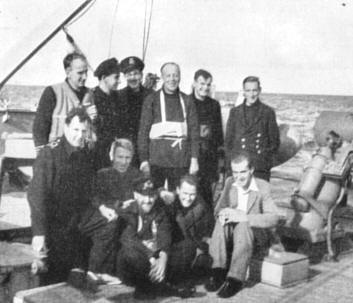
Survivors from HMS Leda (Source:
PQ17 - Godfrey Winn)
When we had left the White Sea, it was touch and go as to whether we
had enough food to see us through, water too was going to be a
problem. We had picked up the men from the LEDA, and they had now been
biting into our rations for over two days. With over two hundred souls
onboard things were getting a bit chaotic, and with all these extra
mouths to feed, I had estimated that we should be lucky if we lasted
two more days with the food we had, though the water situation was not
too bad as yet.
Conditions in both the seamen's mess and the petty officers' mess were
terrible, with all the bunks full and men either standing or lying on
the decks, taking up every available bit of space. Moreover there were
many of the merchant seamen who would not go down below, and just
roamed about the upper deck, blocking the entrances to the various
companionways, which would have obstructed our crew getting to their
action stations if the need had arisen again, but fortunately it did
not. While we were steaming, the dead American fireman who had been
brought onboard from the SS Bellingham had, because of the situation
we were in, been buried while the Gem was forging ahead, a thing we
had not liked to do, but had to.
Now
I was called to take the helm it seemed as though the answers to the
signals had come through, for I was told that we were to go alongside
one of the destroyers to pick up some food. Which one I don't
remember; it could even have been the Somali. It probably was for she
had to be lightened and many things were ditched over her side.
However it was always a ticklish piece of work going alongside another
vessel, as one had to keep an eye open for anything to happen. This
time we went close enough for them almost to pass the cases of tinned
stuff over, with the use of a heaving line. Soon that job was done,
and it was time for us to close on the Seagull, onto which ship we
transferred two naval officer survivors from the LEDA, and thirty-one
naval ratings along with three merchant navy seamen who were
transferred to the SS Rathlin. So this made things a bit easier on the
Gem. At first it seemed to us that most of the merchant seamen wanted
to go, as they had not been too pleased about being picked up by a
small trawler, but when they were given the chance to go, only three
went, the remainder saying that they stood a better chance of getting
home on a small ship. In the words of one man when asked if he wanted
a transfer to the Rathlin, 'The chances of my being tin-fished on this
"Coggy-boat" are far less than on one of yon big uns.'
Source:
http://www.naval-history.net/WW2Memoir-RussianConvoyCoxswain06.htm
COXSWAIN IN THE NORTHERN CONVOYS - S.A. Kerslake published by William
Kimber, 1984 |
|
|
SECRET
From …H M S
Northern Gem
Date … 2nd
October 1942
To … A C I C
Subject:
REPORT OF NORTHERN
GEM’S MOVEMENTS AFTER HMS LEDA HAD
BEEN TORPEDOED
Sir,
I have the honour
to submit my report on the movements of HMS Northern Gem after HMS
LEDA had been torpedoed.
HMS LEDA was
torpedoed at 0523, British Summer Time on the 20th
September 1942. At this time, Northern Gem was stationed about one
and a half miles on the port beam of LEDA and two miles astern of
the convoy.
A muffled
explosion was heard and flames were seen to come from LEDA’s funnel.
Full speed ahead was immediately rung and the helm put
hard-a-starboard to bring Northern Gem on to the starboard side of
the torpedoed vessel, this being the weather side. LEDA appeared
then to be well afire amidships and breaking in two. Some of her
crew were seen to be mustering on the forecastle deck. Northern Gem
was stopped about 50 yards on the starboard bow of LEDA and boats
were lowered and ordered away. Northern Gem was not put alongside
LEDA as men were seen to be jumping into the sea through the hole in
her side and, at this time, others began sliding into the sea off
her foredeck. Shortly afterwards, LEDA turned turtle and large
quantities of oil appeared on the surface of the water making rescue
operations very difficult. The large majority of the men in the
water were naked and their oil covered bodies made it difficult for
my boats’ crews to get a strong grip on them; many of the men were
hardly able to help themselves owing to the coldness of the water.
Sixty two men were
eventually picked up by Northern Gem, three of whom succumbed either
aboard the ship of from their immersion in the water. Three other
men were known to have been drowned by slipping through the grasp of
their would-be rescuers.
By the time
Northern Gem left the scene of the disaster to proceed to catch up
with the convoy, now 10 miles ahead, no man was left in the water.
I should like to
pay a great tribute to all my ship’s company for their untiring
efforts to save every possible man, under the most difficult
conditions. The small boats manned by Skipper Buchan, Acting Leading
Seaman Coleman, Seamen Jones, Budd and Robins and Seamen A/S
Sullivan and Thomson stuck well to their arduous task; Acting
Leading Seaman Coleman, Seaman Jones and Seaman A/S Sullivan were
particularly noticeable.
On the morning of
the 22nd September, 22 survivors were picked up from RFA
Grey Ranger and 21 from the American Steamship Bellingham.
I have the honour
to be, Sir,
Your most obedient
servant,
Lieutenant
Mullender
Commanding Officer
From : Rear
Admiral (D)’ Home Fleet
No. HD571 of 15th
November 1942
To: Commander in
Chief Home Fleet
The names of the
Officers and ratings whom it is considered are deserving of
inclusion in the recommendations for operational awards are:
Acting Temporary Skipper Thomas Buchanan,
RNR
Acting Leading Seaman Ezer Coleman
LT/JX216503
Seaman Charles Henry Jones LT/JX 260764
Seaman S D John William Sullivan X 19943A
For courage and
continued devotion to duty under most difficult conditions in saving
lives of many Officers and men of HMS LEDA after she had been
torpedoed.
The Commanding
Officer HMS LEDA reported that:
‘The large majority of those who got away from
the ship were picked up in spite of the low temperature of the water
and the fact that most of them were immersed in fuel oil. This is
largely due to the excellent work performed by … HMT Northern Gem … I
cannot speak too highly of their efforts in picking people up...’
Source ADM1/12300 Northern Gem Recommendations for Awards for services
rendered after HMS LEDA had been torpedoed |
|
|
Report of Medical Officer, HMS Somali
'On September 20 H.M.S. Leda
was torpedoed and sunk. Her survivors were picked up by H.M.S.
Seagull, and included 6 casualties who had been immersed in the
sea for thirty minutes. Fortunately the air temperature at the
time was as high as 31°F,
and sea temperature 40°F.
'As the
Seagull had no medical officer on board, Somali was ordered to
close her and render medical assistance. A whaler was lowered
and I was transferred to Seagull.
'On board
her I found that one casualty from the Leda was already dead. I
could see no sign of injury on him and concluded that he must
have died of exposure. Two other men without obvious injuries
were receiving artificial respiration, but they too died shortly
afterwards. One other casualty had a fractured femur and burns,
and there was a second case of extensive burns which proved
fatal.
'I
remained on board H.M.S. Seagull, and the following day we
picked up a number of survivors from a torpedoed merchant ship.
'There
were no further incidents, and we arrived at Scapa Flow on
September 26 and transferred the casualties to the Hospital Ship
Amarapoora.'
This transfer of the Medical
Officer of the Somali to the Seagull was unfortunate in that his
absence was soon keenly felt in his own ship. Nevertheless, the
transfer may well have saved the medical officer's life because
H.M.S. Somali was herself torpedoed later on September 20.
Source: The Royal Naval Medical Service Vol II, JLS Coulter
|
|
|
44 Officers and men were
killed |
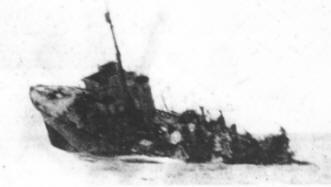
HMS Leda sinking (Photo from U435)
Source:
Convoys
to Russia 1941-1943 Ruegg & Hague
|
|
It was seven o'clock in
the morning, and the telephone beside my bed was ringing and a woman's
voice I did not recognize was asking to speak to me."They gave out over the
wireless last night that the LEDA had been sunk. But they made
no announcement about casualties. Could you possibly find out if my
husband is all right?"
I marvelled at her
composure, but then that was the way my own Captain's wife would have
behaved, too. "The one good thing I ever did was to marry the right
girl." On my return I had written and told her that and many other
things beside and now I saw her husband's ruddy, open face, saying
goodbye to me on the quayside. I certainly had not recognised death in
his eyes that day. Was I still drugged and dreaming this conversation?
With an effort I pushed the bedclothes back off my chest, as though
with the same gesture to free my mind. From a long way off, at the
other end of a tunnel I heard myself answer. "I'll ring up the
Admiralty at once, Mrs Wynne‑Edwards.
This was something I
could do legitimately without feeling I was being a confounded
nuisance. And the news they we able to give me, in due course,
checking the names, sent me rushing to dial "Telegrams". For the
LEDA's Captain was among the rescued. He was safe, on land. One
vigil at least through the long night was at an end.
Later that day, a
telegram arrived for me at the flat. I am looking at it now, and it
still states the same simple fact.
“THE SWIM WAS RATHER COLD
BUT I MADE IT.
I WILL GIVE YOU A RING.
PILOT. LEDA.”
That evening for the
first time I had no inclination to walk aimlessly about the streets,
or take refuge among the mirrored reflections in the Regent Palace. I
was no longer afraid of my own company, alone in the flat, as I waited
again for the telephone to ring. However, in the end it was not till
three days later that he came, and I remember how he was dressed in a
borrowed Civvy suit, and started to apologize for that, as soon as he
was inside the door.
"But my new uniform will
be ready on Saturday," he went on, quickly. "I have already been to
the Admiralty to ask when I can have another ship, but they say I've
got to wait a fortnight at least …” I started to get Aarl a drink,
until I remembered that was no ‑use. "Nice place you've got here.” I
don't think I made any reply, standing, there by the fireplace,
awkwardly waiting. There was a pause. We both knew what in the other's
mind. The Roll Call. "We lost the Doc.," Pilot said, at last.
As he spoke, he was
holding his two hands very tightly clasped together against his knees.
I've seen other men make the same movement when they are talking of
the same thing.
"They got us in the dawn.
You know how it is yourself, those hours at sea the dusk and the dawn.
I was asleep in my cabin and the next thing I remember was being on
the quarterdeck and the ship split in half. Yes, right in half.
Afterwards they said it was a tremendous explosion, but the funny
thing is I can't remember any noise at all, I only remember the oil
everywhere and a kind of numbness, as though I was still asleep ... we
tried to launch a whaler ... the one you went sailing in sometimes, in
the dog‑watches ... but it was too badly damaged by the explosion ...
so in the end I shouted out to Pen, who was on a Carley float, 'Any
room there?' and he shouted back, 'Come on,' and I dived over the side
into the oil. There were quite a few of the crew on the Carley float,
and later we fished the Sub. out of the water. When he came round at
last on board the rescue ship, he kept on saying, 'Please take me out
of the Drink, please take me out of the Drink!' No one could make him
understand at first that he was O.K., among friends. . . .”
He broke off, but I found
myself prompting him at once.
"You haven't told me
about the Doc,'' I said.
"Didn't I?' His eyes
flickered away across the room.
“There isn't much to
tell, except that his strength must have given out before he reached
the Rathlin. She rescued most of those who were saved, and her
captain was wonderful, both at the time, hoving‑to, and putting the
nets down, when it looked like suicide for her ‑ they got seven ships
you know, coming back ‑ and afterwards, too, he was so good looking
after the wounded and the survivors. In fact, they were all so good to
us on board. I was very happy when your ship just before we parted
company, sent Captain Banning a signal. I made a copy for you. Look,
here, it is. 'Goodbye and good luck to a gallant ship and a gallant
ship's company'."
I could hardly
concentrate on reading the words that were on the slip of paper. "You
mean, the Pozy was with you?"
"Oh, yes, didn't you
know? And the Bramble and the Seagull and . . ."
I interrupted him again.
“But she's all right? The Pozy, I mean..” "Oh yes, rather. The
Pozarica and the Palomares split up and went to Belfast."
A wild rush of excitement
and relief flooded my being and then the next instant 1 felt my heart
contract again. "But the Doc ......
“I told you, didn't I?
His strength must have given someone saw him sink, there was nothing
to do, he was too far away; you know how it is in those seas ... many
went like that. . . ." Then there was silence for a moment before he
added, “We always used to say he was the fittest man on board; you
remember how proud he was of the way he kept so fit."
Yes, I remembered. And
something else, too. How I had been told that in the beginning he had
served in the Merchant Navy, in peacetime, until one day he had fallen
down a hatch and been so battered about, with such multiple injuries,
he should have died then, so his recovery was a miracle of science.
Indeed, so impressed was he by the doctors' skill who succeeded in
patching him up again that he made a vow to become one of them himself
and minister, as they ministered, to his fellow men. And the day came
in Glasgow that it was so: but the war came, too, whereupon he at once
volunteered to go back to sea. And now the rest was the silence of the
Barents Sea.
But surely we who knew
him, even for a short space of time, would not forget such a man, or
his example, I told myself, nodding when my companion announced that
the LEDA's Captain had been saved. That was something I knew
already: but the other thing: the reason why a human being is rescued
and brought back from the borders of the unknown land, only to be lost
so soon afterwards in the grey waters of a distant sea, that was
something beyond me to answer or rightly understand, and once again, I
heard my own Captain's voice, in his cabin, exclaiming:
"Do you really mean to
tell me that the Almighty stretched out His hand, and said, I want you
and you and you, that some were worthy to be picked up . . . but
others not ......”
The question, of course,
would go on being asked so long as there was human life upon the
earth. But I did not realize that a few months later I should
be asking it already again myself about the fellow human being, at
that moment sitting in my flat who, like the Doc had crossed my path
for such a little while, but contact with whom would make me conscious
for the rest of my days what it really means to be pure in heart.
"Of course, the Old Man
was the last to leave the ship," he was saying. "Do you remember what
a good sport he was at the Old Sockites Party? You know, I should like
to sail with him again, as soon as I am rigged out."
Again I nodded. "Did you
save anything, Aarl?" I suddenly asked. "Not even the photographs of
your wife?" But he only shook his head and with an abrupt movement
jumped to his feet.
"Come on, what show are
we going to? Fine and Dandy. That's a good title, anyway! Do
you know, it is the first time I have ever seen a show in London!"
And for the first time,
as one scene followed another, and the music and the lights began to
act like a drug, while the dancing girls passed like phantoms of
enchantment ‑across the stage‑for this must always be the mirage, the
other the reality now‑1 saw his bands relax, slide off the side. of
his knees, and with a sigh, rubbing his back against the comfortable
stall, he exclaimed softly:
"This is what they all
used to talk about out there, at the Welcome Inn. A show, and Big Eats
afterwards. . . ."
Later on, when there was
a topical sketch with Leslie Henson, attired in full feathered regalia
as a hen, egg‑bound through too much blitzing, he turned to me again:
"Do you know, the night before we sailed, I managed to scrounge fifty
pounds of potatoes. Fifty pounds! It was marvellous. We planned it all
out that it would be a potato for every chap, every day until we got
home."
I wish, in a way, he
hadn't said that. It would have made it easier now to turn over the
page. Instead, I know it's foolish of me, but I still cannot get out
of my mind the potatoes that were wasted, in the end.
Source: Extracts from ‘PQ17’ by Godfrey Winn who travelled to North
Russia aboard HMS Pozarica |
|
|
..Commander
Wynne-Edwards (of the recently sunk HMS LEDA) turned up too, not
looking in the least like a survivor who, a fortnight before, had
been clinging to a Carley float, but in a brand new uniform, and
with a brand new ship awaiting his command, to take over from a
Yankee shipyard, and yes, he had equally positive news of Aarl.
“He's got promotion. He is to be the Pilot of the Bramble, when she
goes back to Russia. He's tickled to death,”his late Captain
added.
“And what about your No.1 in the LEDA?” I asked. “I suppose you've
heard he's made it with his girl in Aberdeen. He sent me a piece of
the cake. I meant to keep it for today, but I ate it!”
“No.1 in the LEDA? Oh,
he's going back on the same run too as No.1 in the Bramble. That's a
step up for him, also. Benson is getting his brass hat, you know.
While M.S.1 is due to go to the Admiralty, as Director of
Minesweeping.”
Source: Extracts from ‘PQ17’ by Godfrey Winn who travelled to North
Russia aboard HMS Pozarica |
|