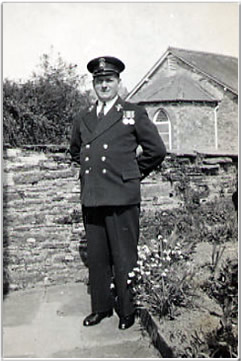






Chief Petty Officer Bill Stone
One of the last survivors of both world wars who served with the Royal Navy for 30 years, witnessing events from the scuttling of the German Fleet to Dunkirk
Chief Petty Officer Bill Stone, who died on January 10 aged 108, was the last man to have served in the Royal Navy during both world wars.
When Stone received a letter summoning him to Exeter for conscription into the army in September 1918, he took the train to Plymouth and joined the navy instead. He served for only a few months of the First World War and, on Armistice Day, was under training at the naval barracks at Devonport.
Spanish flu, which killed more men than all the casualties of the war, was then raging and Stone contracted it, collapsing with his head in his dinner. Later, in the sick bay, he heard the man in the next bed say he felt better and the doctor reply: "Fourteen days leave!" Stone repeated the fib, and also obtained leave.
When a brother who was a stoker asked why he had become an ordinary seaman, he replied that he didn't know, and transferred to stoking. The following year he joined the three-funnel battle cruiser Tiger at Rosyth. When he failed to rise at 5.15 on his second morning, the chief stoker shouted at him: "What's the matter with you? Out of that bloody hammock at once and run down the passage singing 'Should auld acquaintance be forgot'."
Shortly afterwards Stone witnessed the scuttling of the German High Seas Fleet at Scapa Flow. He had vivid memories of the stoker's job of trimming the bunkers when hundreds of tons of coal had to be embarked at speed. Worse, he recalled, were his watches when the four furnaces had to be cleaned out.
Hot ash had to be removed with a shovel, before lumps of coal were broken up, and the furnace was laid and ignited with scoops of burning embers from the next furnace. Even in the heat of the boiler-room Stone wore a cap, to keep the condensation off, while sucking a piece of coal to keep his mouth moist. Between watches he hung his clothes on a rail, and, afterwards, his trousers, stiff with perspiration and coal dust, would stand up on their own.
The 10th of a farm labourer's 14 children, William Stone was born on September 23 1900 at Ledstone, Devon, and was educated at the village school in Goveton, where there were two schoolmistresses and 20 pupils. At 13 he left home to work on a nearby farm and, two years later, he walked to Kingsbridge to join the navy. But his father, who had four brothers and three sons at sea, refused to sign his papers. While other farm labourers joined the Army, never to return, young Bill drove a water cart and, later, a steam roller before getting his chance when he was called up two weeks before his 18th birthday.
He sailed to Spain in Tiger, where he bought eau de cologne, a Jacobs pipe, and later, three sets of clippers, scissors and comb from the ship's barber, who was retiring. He used these to good effect in the battle cruiser Hood, when he and a marine bandsmen shared a cabin equipped with a mirror, charging 4d a time for haircuts, until he discovered that the marine was charging 6d but entering 4d in their joint accounts.
In November 1923 Hood set out on a voyage round the Empire, known to the sailors as "the world booze cruise". After visiting Cape Town, Adelaide and Wellington (where he was given two weeks' leave to visit an uncle) the ship passed through the Panama Canal and up to Halifax and St John's. By the time she returned to Devonport after nine months Stone had earned the considerable sum of £100 with his clippers.
He was next drafted to the sloop Chrysanthemum, based at Malta, where he remembered being liberally paid in tots of rum, and then into the submarine chaser P40. He then went to the carrier Eagle, on which one of his customers was the Spanish pilot Ramon Franco, brother of the future Spanish leader, who had been picked up several days after crashing into the Atlantic.
A spell in the destroyer Thanet was followed by another in the cruiser Carlisle on the South African station, when she had the unusual task of delivering a live bull to the island of Tristan da Cunha.
Back home, Stone was posted to Harebell, a fishery protection sloop whose skipper was in the practice of giving half the crew leave and then go off fishing himself. On one such leave, Stone took the opportunity to marry Lily Hoskin, with whom he had a daughter the week before war broke out in 1939.
He was in the Grimsby-based minesweeper Salamander the following year when she ferried troops back to Dover from Dunkirk. As the men waded and swam out under fire, he helped to haul them on board, and took potshots with a rifle at the low-flying Germans. Salamander was hit several times but completed five trips and brought back some 1,000 soldiers. Some had no clothes and, when one grabbed Stone's coat as he went up the gangplank, Stone said: "Good luck to him." On returning to port for the final time Stone learned that a submarine had fired a torpedo at Salamander, but it had passed underneath the ship's shallow draft.
After minesweeping operations based at Murmansk, he was sent to the new cruiser Newfoundland, building in the Tyne; Stone's comment about being in harbour after over a year at sea was succinct: "It was nice."
Newfoundland became flagship of the 15th Cruiser Squadron in the Mediterranean and was covering the Allied landings on Sicily when she was torpedoed in the rudder on July 23 1943 by Kapitänleutnant Ernst-Ulrich Brüller's highly successful submarine U-407. She limped to Malta where emergency repairs were carried out before crossing the Atlantic, steered only by propellers, for major repairs in the Boston navy yard.
Stone was mentioned in despatches for his part in saving her. After eight months she visited St John's, the capital of her namesake Newfoundland, where a dockyard matey shouted at him: "Take care of that ship, Chief, I gave half a crown towards her."
When the war ended in May 1945 Stone was given khaki uniform to wear with his naval cap and trained to use a revolver before being sent to the island of Sylt, off the northwest German coast, where he and 12 men were charged with guarding against any possible pockets of resistance.
On returning home, Stone took up a full-time career as a hairdresser, buying a barber's and tobacconist's shop in Paignton, where he prospered until he could retire to a house overlooking Torbay. In his latter years he moved close to his daughter at Watlington, Oxfordshire, where he kept himself busy as a member of the Royal British Legion and several veterans' associations. He was proud to have met many members of the Royal family, and claimed to be having the time of his life in his second century. When attending reunions he liked to sing All the Nice Girls Love a Sailor and then Abide with Me.
Bill Stone attributed his long life to his faith and a prayer taught him by his wife (who died in 1995): "Lord, keep us safe this night, secure from all our fears, and may angels guard us while we sleep till morning light appears."