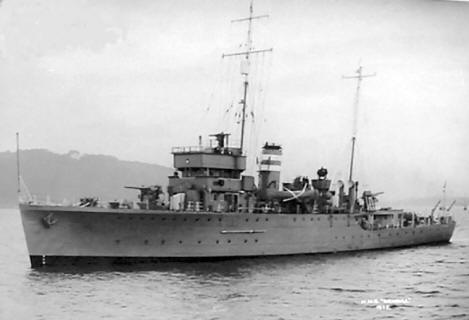
Summary of History
Completed on 30th May 1938, Seagull
(J85) was the first 'rivet-less' ship in the Royal Navy, all the joints
being welded. SEAGULL and Leda were sent for rough weather trials in
Icelandic waters on 15th September 1938 and arrived at Scapa on 27th
September having experienced sufficient rough weather to give a
thorough test of the structure of SEAGULL. She started the war
at Scapa and remained in Scottish waters until 1941, when she joined
the 2nd Escort Group (Londonderry).
In October 1941 she joined PQ2, the
first of 21 Russian convoys that she was to help escort. She returned
briefly at the beginning of 1942 for arcticisation, then sailed again
in April for Russia where she remained until September. On 2nd
May 1942 she sank the Polish submarine Jastrzab in error (the
submarine was in the wrong location). Once more in December 1942 she
sailed to North Russia, only to return in Feb 1943 for boiler repairs.
In October 1943 she went back to Russia for the fourth time. In
March1944, along with HMS Gleaner, SEAGULL returned from Russia
for the final time. They were the last Halcyons to leave after years
of gruelling and distinguished service. For Operation Neptune, SEAGULL
was with the 1st MSF at Normandy, she swept channel 9 into Sword
Beach. She spent the rest of the war based at Harwich, minesweeping.
In late 1945 SEAGULL was converted
in Rotterdam to a Survey Ship. She operated in Home Waters until 1950
when she paid off into the Reserve. She became the naval drill ship at
Leith in 1955 before being scrapped in May/July 1956 at Plymouth.
See also
www.naval-history.net