



|
|
This page contains all the names of crew members that have been found
so far. If you can add to the information please
contact me.
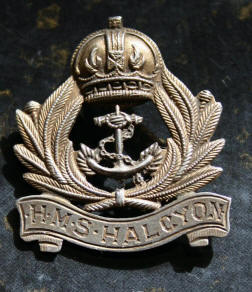
Cap Badge found the in soil of a garage floor in Cornwall
2009
|
Crew Members who lost their lives while
serving on HMS Halcyon |
|
LAST
NAME |
FIRST
NAMES |
RANK |
SERVICE
NUMBER |
DATE
OF DEATH |
AGE |
FAMILY
DETAILS |
COMMEMORATION
DETAILS |
|
THURSTON |
Nigel
Vere Broke |
Lieutenant |
|
3rd June 1940 |
25 |
Son
of Lieut-Colonel Vere Broke Thurston and Claire Burlinson Thurston, of
West Monkton; husband of P D B Thurston.
Awarded the Harold Tennyson Prize, R.N. College, Dartmouth |
WEST MONKTON (ST AUGUSTINE) CHURCHYARD
Somerset
South
of church tower |
|
VINCENT |
Francis |
Able Seaman |
D/JX
137430 |
2nd June 1940 |
34 |
Son
of William and Eveline Eliza Vincent, of The Borough, London |
DOVER
(ST JAMES'S) CEMETERY Kent
Joint grave 6 |
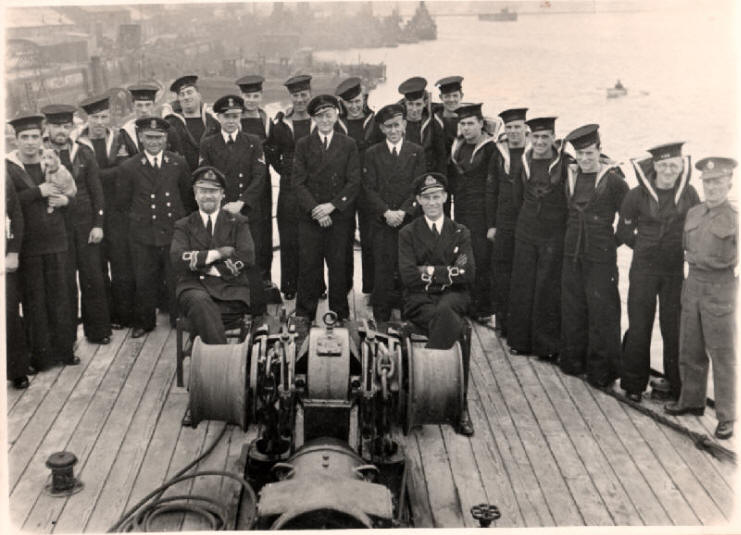
Photo believed to have been taken on HMS
Halcyon
Source: John Jenkins
|
Commanding Officers |
From |
To |
| |
|
|
| Cdr. L.V. Lloyd, RN
(retired) |
15 June 1939 |
12 Oct 1939 |
| Cdr. St. John Cronyn,
RN |
12 Oct 1939 |
8 April 1940 |
| Lt.Cdr. J.M.S. Cox,
RN |
8 April 1940 |
30 May 1940 |
| Cdr. Eric Percival
Hinton, MVO, RN - DSO awarded on 16 August 1940 |
30 May 1940 |
15 Oct 1940 |
| T/A/Lt.Cdr. H.
Harding, RNR |
15 Oct 1940 |
18 June 1942 |
| Lt.Cdr. Colin Henry
Corbet-Singleton, DSC, RN |
18 June 1942 |
2 Feb 1943 |
| T/A/Lt.Cdr. Harry
Layland Dudley Hoare, RNR |
2 Feb 1943 |
12 July 1943 |
| T/A/Lt.Cdr. L.J.
Martin, RNVR |
12 July 1943 |
20 March 1945 |
| T/A/Lt.Cdr. E.A.C.
Philipps, DSC, RNR |
20 March 1945 |
- |
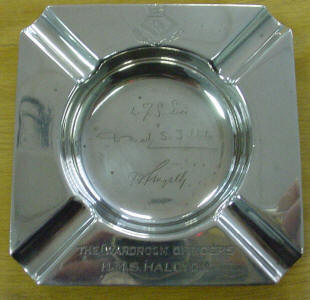
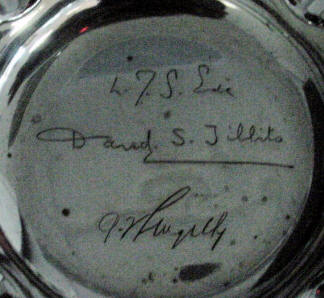
Ashtray signed by 'The Wardroom Officers,
HMS Halcyon'
Signatures of L T S Ede, David S Tibbits and G F Pengelly
(Source: Ian Clue)
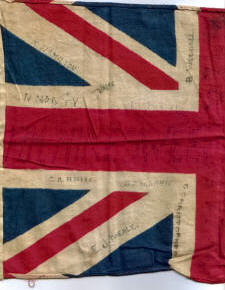 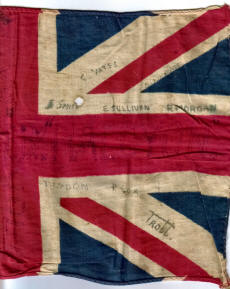
Across the centre
this Union Flag has written on it: 'HM
Minesweeper Halcyon' (horizontal) and 'May 8th
1945' (vertical). The names signed on the
reverse (shown) are the names R Hamilton, C R
Ariss, D J Morris, E J Kneale, F Christopher, T
Lydon, P Cox, Trott, E Sullivan, R Morgan, C
Yates, J Smith, R Woodall, J Waite, N Monty, P
Border.
(Source: Sue Chapman,
daughter of Robert Hamilton)
|
Other Members of the Crew of HMS
Halcyon |
|
LAST NAME |
FIRST NAMES |
RANK |
SERVICE NUMBER |
DATE
|
AGE |
SOURCE
|
|
Acland |
Hubert Guy Dyke |
Captain |
|
12.3.34 - 7.35 |
|
C O & S O 1st MSF
http://www.unithistories.com/ |
|
Armstrong |
James |
Leading Stoker |
KX 95214 |
27.5.41 - 3.11.43 |
|
Sadly my father is no longer with us
having died in 1971.
Source: Jimmy Armstrong (son) Feb 2009 |
|
Ariss |
C R |
|
|
|
|
Name written on HMS Halcyon Union flag
dated 8th May 1945. Source: Sue Chapman, daughter of Robert Hamilton |
|
Bayley |
Bill |
Cdr |
|
|
|
http://www.bbc.co.uk/dna/ww2/A2021446 |
|
Border |
P |
|
|
|
|
Name written on HMS Halcyon Union flag
dated 8th May 1945. Source: Sue Chapman, daughter of Robert Hamilton |
|
Bradley |
Fred |
First Lt |
|
1941 |
|
http://www.bbc.co.uk/dna/ww2/A2021446 |
|
Byrne |
T A |
Tempy Lt |
|
6.10.43 |
|
Navy List for July 1945 |
|
Cathie |
C B |
Lt Cdr |
|
27.7.39 |
|
Navy List for Dec 1939 |
|
Cawood |
K |
Tempy Sub Lt |
|
16.3.44 |
|
Navy List for July 1945 |
|
Christopher |
F |
|
|
|
|
Name written on HMS Halcyon Union flag
dated 8th May 1945. Source: Sue Chapman, daughter of Robert Hamilton |
|
Clarke |
J |
Officers Steward |
LX21778 |
1940 |
|
ADM 199/184 |
Corbett‑
Singleton |
Colin Henry |
Cdr |
|
18.6.42 - 2.2.43 |
|
|
|
Cox |
John Mark Symonds |
Lt Cdr |
|
8.4.40 - 30.5.40 |
|
Orde-Dunkirk. Bar to the DSC - London
Gazette Issue 34867 of 7 June 1940 (DSC awarded for services in
Sino-Japanese conflict - Gazette 34763) |
|
Cox |
P |
|
|
|
|
Name written on HMS Halcyon Union flag
dated 8th May 1945. Source: Sue Chapman, daughter of Robert Hamilton |
|
Crawford |
G D |
Tempy Act Sub-Lieut |
|
15.3.45 |
|
Navy List for July 1945 |
|
Cronyn |
St John |
Commander |
|
12.10.39 - 8.4.40 |
|
|
|
Crutchley |
Victor Alexander Charles |
Captain |
|
31.7.35 - 2.36 |
|
SO 1st MSF
http://www.unithistories.com |
|
Ede |
Lionel James Spencer |
Lt Cdr |
|
|
|
See HMS Salamander |
|
Gosling |
Thomas Henry |
Stoker 1st Class |
D/KX105349 |
1940 |
|
With Halcyon until 27.9.40 when hit
mine. Then transferred to Repulse (died when she was sunk 10.12.41)
|
|
Gray |
K H |
Tempy Act Sub-Lieut |
|
10.7.44 |
|
Navy List for July 1945 |
|
Griffiths |
J P |
Tempy Surg Lt |
|
16.10.44 |
|
Navy List for July 1945 |
|
Gurney |
Maurice James (Jim) |
|
|
1940-1942 |
|
http://www.hmshood.org.uk/crew/bios/gurney/JimGurney.html |
|
Hamilton |
Robert William
James |
AB Radar |
JX381101 |
12.12.44 - 4.4.46 |
|
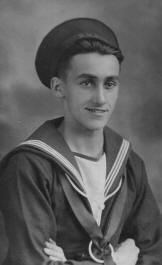
Born
on 3rd March 1924, he died on 8th September 2002 |
|
Harding |
H |
T/A/Lt.Cdr |
|
15.10.40 - 18.6.42 |
|
|
|
Hart |
J A |
Telegraphist |
|
|
|
PQ17 Convoy to Hell, Lund &
Ludlum |
|
Hichens |
Robert Peverell (Hitch) |
T/Lt |
|
12.12.39 - 4.40 |
|
http://www.mcdoa.org.uk/index.htm
See also HMS Niger Crew |
|
Hill |
Joseph Sterndale de
Montelar |
Sub Lt |
|
23.3.43 |
|
Bar to DSC awarded for
bravery, skill and resolution while minesweeping in North Russian
waters in HM Ships Halcyon, Hazard and Sharpshooter. |
|
Hinton |
Eric Perceval (Tishy) |
Cdr |
|
30.5.40 - 15.10.40 |
|
Orde - Dunkirk.
Awarded DSO Supp to London Gazette 16th Aug 1940, No.34925 |
|
Hoare |
Harry Layland Dudley |
T/A/Lt.Cdr |
|
2.2.43 - 12.7.43 |
|
|
|
Hooper |
Richard March |
Paymaster
Sub-Lieutenant |
|
1940 |
|
ADM 199/184 |
|
Horsley |
N |
Leading Telegraphist |
JX135407 |
1940 |
|
ADM 199/184 |
|
Howe |
G W O |
Temp Lt |
|
23.2.44 |
|
Navy List for July 1945 |
|
Isam |
S |
Stoker |
|
|
|
PQ17 Convoy to Hell, Lund &
Ludlum |
|
James |
W V |
Tempy Sub Lt |
|
11.7.44 |
|
Navy List for July 1945 |
|
Jarnet |
Clarence Edward |
AB |
J595955 |
1940 |
|
Orde - Dunkirk.
Awarded DSM - Supp to London Gazette 16th Aug 1940, No.34925 |
|
Jenkins |
Frank |
Leading Wireman |
C/MX76808 |
9.8.41 - 19.7.43 |
|
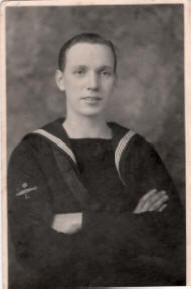 My
father, Frank Jenkins MX76808, was assigned to HMS Halcyon on the
9th Aug 1941 as wireman stayed with HMS Halcyon until 19th July
1943. After this he was at Pembroke and then Europa in Lowestoft
coming out as leading wireman, and assigned to MMS1003 which he
stayed with until the war ended. It was on the MMS1003 in the D-Day
landings that he was awarded the DSM. My
father, Frank Jenkins MX76808, was assigned to HMS Halcyon on the
9th Aug 1941 as wireman stayed with HMS Halcyon until 19th July
1943. After this he was at Pembroke and then Europa in Lowestoft
coming out as leading wireman, and assigned to MMS1003 which he
stayed with until the war ended. It was on the MMS1003 in the D-Day
landings that he was awarded the DSM.
Source: John Jenkins Dec 2008
|
|
Kneale |
E J |
|
|
|
|
Name written on HMS Halcyon Union flag
dated 8th May 1945. Source: Sue Chapman, daughter of Robert Hamilton |
|
Law |
Henry George |
|
|
1943 - 1946 |
|
My father. Henry George Law, served on
the HMS Halcyon from 1943 to 1946. He is still alive and living in
Walton on The Naze Essex.
He joined the London Fire Brigade following the war and enjoyed a
successful 25 year career until retirement. He has fond memories of
his time on board the Halcyon.
Source : Bob Law Dec 2007 |
|
Lewton |
Bertie |
Petty Officer Wireman |
D/MX.62079 |
|
|
Awarded DSM 29th Dec 1944
Source Robert Lewton (son) Feb 2009 |
|
Lloyd |
L V |
Cdr |
|
15.6.39 - 12.10.39 |
|
|
|
Lydon |
T |
|
|
|
|
Name written on HMS Halcyon Union flag
dated 8th May 1945. Source: Sue Chapman, daughter of Robert Hamilton |
|
Mahoney |
Kenneth |
AB |
|
1943 -45 |
|
He was a "Devonport rating" and
recalls being based at Scapa Flow, but can remember very little more
than that. He was born on 2nd August 1925
Source: Paul Mahoney (Son)
|
|
Martin |
L J |
Acting Lt Cdr |
|
12.7.43 - 20.3.45 |
|
|
|
Mason |
|
Lt |
|
1941 |
|
http://www.bbc.co.uk/dna/ww2/A2021446 |
|
McDowell |
Jame |
Sub Lt |
|
|
|
PQ17 Convoy to Hell, Lund &
Ludlum |
|
Mellalieu |
William |
Lt |
|
1941 |
|
Fleet Sweepers at
War, Jack Williams |
|
Messenger |
William Ernest |
Lt |
|
4.46 |
|
http://www.unithistories.com/ |
|
Montgomerie |
T B |
Surgeon Lt |
|
17.6.39 |
|
Navy List for Dec 1939 |
|
Monty |
N |
|
|
|
|
Name written on HMS Halcyon Union flag
dated 8th May 1945. Source: Sue Chapman, daughter of Robert Hamilton |
|
Moore |
John Douglas David |
Lt |
|
July 1940 |
|
ADM 199/184,
http://www.bbc.co.uk/dna/ww2/A2021446 |
|
Morgan |
R |
|
|
|
|
Name written on HMS Halcyon Union flag
dated 8th May 1945. Source: Sue Chapman, daughter of Robert Hamilton |
|
Morris |
D J |
|
|
|
|
Name written on HMS Halcyon Union flag
dated 8th May 1945. Source: Sue Chapman, daughter of Robert Hamilton |
|
O’Flaherty |
Thomas Patrick |
Petty Officer |
JX144278 |
1940 |
|
ADM 199/184 |
|
Pengelly |
George Francis |
Lt |
|
|
|
http://www.britishmedalforum.com/viewtopic.php?t=584&sid=e9be4dc1bb7e408d4134b98fce451a63
|
|
Phillips |
E A C |
Tempy
Lieut Comm |
|
20.3.45 - |
|
Navy List for July 1945 |
|
Picton |
William Hibbert Allanson |
Surgeon Lieutenant |
|
July 1940 |
|
ADM 199/184 |
|
Rowlinson |
A H |
Lt |
|
1.6.39 |
|
Navy List for Dec 1939 |
|
Ruddock |
William |
Leading Seaman |
JX138963 |
1940 |
|
ADM 199/184 |
|
Salmon |
John Henry |
Sto PO |
DK66881 |
|
|
Orde - Dunkirk
- Awarded DSM - Supp to London Gazette 16th Aug 1940, No.34925 |
|
Sinclair |
W A |
Temp Lt |
|
16.3.43 |
|
|
|
Smith |
J |
|
|
|
|
Name written on HMS Halcyon Union flag
dated 8th May 1945. Source: Sue Chapman, daughter of Robert Hamilton |
|
Smith |
R H |
Lt (E) |
|
8.6.39 |
|
Navy List for Dec 1939 |
|
Spicer |
H |
Leading Stoker |
KX82037 |
1940 |
|
ADM 199/184 |
|
Spooner |
E |
Stoker |
KX88693 |
1940 |
|
ADM 199/184 |
|
Sullivan |
E |
|
|
|
|
Name written on HMS Halcyon Union flag
dated 8th May 1945. Source: Sue Chapman, daughter of Robert Hamilton |
|
Sweeny |
James |
Acting Yeoman of Signals |
JX128458 |
1940 |
|
ADM 199/184 |
|
Tibbits |
David Stanley |
The son of a doctor,
David Stanley Tibbits was born at Warwick on April 11 1911, educated
at Dartmouth in the St Vincent term and went to sea aged 16. After
serving in the battleship Queen Elizabeth, flagship of the
Mediterranean Fleet, Tibbits became one of the youngest officers to
specialise in navigation. As the junior member of his course he
expected the dullest appointment until a colleague fell sick, and he
was given a pierhead jump to the minesweeping sloop Scarborough
on the American and West Indies Station.
Luck continued to
play a part in Tibbits's career, and two days after the sloop arrived
at Bermuda he met his future wife. As war loomed, he served in a
minesweeping flotilla during the Abyssinian crisis, in the minesweeper
Halcyon during the Spanish Civil War, and was navigator
of the 1st Submarine Flotilla at Malta.
At the start of the
war, Tibbits was in the heavy cruiser York, with which he saw
nearly every campaign of 1939 to 1941 until she was wrecked in Suda
Bay, Crete. He tried to save York, when she was badly damaged
by Italian explosive "suicide" motorboats, then beached her; but there
she became a sitting duck for German air attacks.
Eventually Tibbits
was evacuated in the light cruiser Orion, in which he was
subjected to heavy bombing. He returned home via the Cape as a
passenger in the liner Otranto to join the cruiser
Devonshire.
On November 22 1941,
Devonshire found Atlantis, a disguised German raider
which had sunk 22 merchant ships of some 150,000 tons. Tibbits
identified the enemy from a picture in the American magazine Life
and navigated Devonshire as she destroyed the raider. This
involved launching her reconnaissance aircraft for early
identification, manoeuvring outside the enemy's gun range, signalling
for confirmation of false identity and setting her on fire with just
four salvos from her 8 in guns.
Atlantis
had been supplying U-boats which were still in the area, so her
survivors were left in their lifeboats. Next Tibbits planned Operation
Ironclad, the invasion of Madagascar. This required a difficult entry
at night by a large fleet into Courrier Bay, which Tibbits achieved
undetected and unopposed; he was awarded the DSC.
In 1944, Tibbits
worked in the stables in Southwick House, outside Portsmouth, on the
plans for the D-Day landings. This was followed by appointment to the
battleship Anson, destined for the British Pacific Fleet and
the relief of Hong Kong.
Source: Daily
Telegraph Obituaries - Captain Sir David Tibbits 2.6.2003 |
|
Trott |
|
|
|
|
|
Name written on HMS Halcyon Union flag
dated 8th May 1945. Source: Sue Chapman, daughter of Robert Hamilton |
|
Vann |
Bernard Geoffery |
Sub Lt |
|
May 1940 |
|
Orde - Dunkirk,
ADM 199/184 |
|
Waite |
Jonny |
|
|
|
|
Name written on HMS Halcyon Union flag
dated 8th May 1945. Also, best man at Robert Hamilton's
wedding.
Source: Sue Chapman, daughter of Robert Hamilton |
|
Welch |
J T C |
PO |
|
|
|
PQ17 Convoy to Hell, Lund &
Ludlum |
|
Woodall |
Roy James |
|
|
1942-46 |
|
My grandad James Roy Woodall was on the
ship HMS Halcyon from 1942 till 1946 and was on Russian convoys. He
was born in September 1924 and died in March 2003.
Source: Damjan Krstajic,
grandsonAlso, his name was
written on HMS Halcyon Union flag dated 8th May 1945.
Source: Sue Chapman, daughter of Robert Hamilton |
|
Worthington |
John Francis |
Sub Lt |
|
28.5.40 |
|
Orde - Dunkirk.
Awarded DSC- Supp to London Gazette 16th Aug 1940, No.34925 |
|
Yates |
C |
|
|
|
|
Name written on HMS Halcyon Union flag
dated 8th May 1945. Source: Sue Chapman, daughter of Robert Hamilton |
|
|
|
|
|
|
|
|
|
|
|
|
|
|
|
|
|