






|
|
|
Date of Arrival |
Place |
Date of Departure |
Orders, Remarks etc |
|
? |
Dundee |
2.2.42 |
2/1 Docked in West
Graving Dock, Dundee
4/1 Undocked
Arrives Scapa 1/2 on completion of trials |
|
|
25th Jan 1942
We went to a Burns supper the other night. Quite an old fashioned
evening with very good speeches. The party unaccountably finished in
a tailor's shop, the owner of which was firewatching and had a
bottle of whisky in the office. He hadn't when we left!
Source: Letter
home to his wife by Lt Thomas Johnston, donated to site by his son,
Peter Johnston. |
|
3.2.42 |
Scapa |
? |
|
|
? |
Loch Ewe |
12.2.42 |
|
|
? |
Kirkwall |
14.2.42 |
|
|
14.2.42 |
NIGER (Senior Officer,
Escort) and Hussar formed part of the ocean escort for PQ11 (13
ships). The convoy averaged about 8 knots in the rain, fog and snow
that hid it from the enemy aircraft. Gales threw spray over the ships,
freezing the gun mounting and the depth charges to their racks, and
threatening the stability of the small escorts. As soon as the weather
moderated all hands were turned out to clear the ice with steam hoses,
shovels and picks.
From 17 to 21 February
the escort was NIGER, HUSSAR, OXLIP and SWEETBRIAR; the cruiser
NIGERIA joined for the 21/22 Feb, and on the last day (23rd) two
Russian destroyers joined. A speed of about eight knots had been
maintained and the enemy had failed to make contact.
Harrier, Hazard and
Salamander provided part of the eastern local escort on 22/2, arriving
at Murmansk later that day. No enemy action. |
|
|
Feb
42
Whilst writing to you
yesterday the bottom dropped out of the thermometer, 20 degrees in 3
hours. My rig for the morning watch 4 to 8 am, was underwear,
thickish socks, seaboot stockings and flying boots, pyjama trousers,
fleece lined corduroy trousers, shirt, fisherman’s sweater, woollen
scarf round middle, fleece waistcoat, light leather jacket, wool
muffler, fleece lined overcoat, fleece lined helmet, mittens and
fleece lined gloves. At the end of an hour both feet and hands were
freezing, but that was all except the nose which seems to catch a
bit. This is due to the wind, the actual cold is nothing much
without the wind.
...next day….
The cold is still with us and
I now have a nice snow field around my porthole, when it melts it
will join all the other condensed water in company under my bunk.
The chief and I have the two aftermost cabins and, since the ship
tends to be down at the stern, all the condensation from all the
other cabins in the flat tend to run into ours. I don’t mind if it
doesn’t drip onto me in the night!!
To pass the time we’ve
started a “Dogwatch” Monopoly school and are becoming quite expert –
You would enjoy it!! I seem to have gained a reputation for being a
hard bargainer, quite unjustified of course, for I am most generous
really.
--------------------------
1st March
1942
Since I wrote the other letter, nothing
interesting to the outside world has happened although we have
been messed about so much that it seems like the old days in the
“Elgin” on the east coast. There are several of our flotilla
mates in the vicinity, but we do not congregate in so much of a
bunch as in the old days, and they have changed so much in their
wardrooms of late that I don’t seem to know half of them. This
is a result of so much inactivity and the expansion of the
service I suppose. We reckoned today that I had been No.1 of a
fleet sweeper longer than anyone else in the home Flotillas, so
now they call me the oldest inhabitant!!
We are all bearing up
alright in the ship and the cold does not seem to bring any ill
effects with it, but there is little opportunity for going
alongside or ashore though what we’ve seen of the shore doesn’t
make that much of a loss. The Sub Lieutenant, South African, has
had to be sent home for medical reasons which will leave us a
bit short handed, until, if at all, a relief arrives. Very
naturally he is sick about it and we are sorry to leave him.
Source: Letter
home to his wife by Lt Thomas Johnston, donated to site by his son,
Peter Johnston. |
|
3.3.42 |
Able Seaman
Harold Edward Sarsfield C/JX171537 died ashore age 25.
This extract from Lt Johnston's
letter seems to relate to this event:
Another bit
of business new to me was a burial at sea the other day, and,
although the ships were rather cramped it is really rather an
impressive ceremony when carried out with gun crews closed up at
their guns and sunlight on snow covered coast in the background. All
hands being dressed in sheepskin coats and caps. The sale of
effects, the customary way of raising money from his messmates for
the widows raised nearly £200 from a ship's company of 113! Gear is
sold 3 or 4 times over and, as an example, in one case a tin of
tobacco realised £12 and remained unsold at the end.
|
|
5.3.42 |
On 5th
March HMS NIGER and Speedwell went to search for the Russian destroyer Gromki who had run out of fuel when returning from escorting convoy
QP8 and was drifting. They provided an A/S screen for her at
daylight on 6th March when she was in tow of a tug.
NIGER sighted and
apparently unsuccessfully attacked a U‑boat off Teriberssky (69.2ON,
35.3OE).
|
|
|
CLICK HERE for report of attack on
U Boat by HMS Niger
|
|
|
8th
March (they say it's a Sunday)
We've had
two bits of excitement, one not altogether concerned with the war.
T'other night we were lying alongside another ship at the wharf
when, with no notice at all, the wind rose to well above gale force.
Inside five minutes all our wires parted and we went careering madly
across the not very large harbour.
Having
been alongside we had no steam on the engines, it was snowing so
hard that you couldn’t see 15 yards at times and to get for’ard to
let go an anchor a Petty Officer and myself had to crawl on hands
and knees. Just as we arrived there we collided with another jetty
and rebounded, collecting a small tug and a lighter lying peacefully
alongside, swung round on the anchor, which, by some miracle held
temporarily, and with the lighter and the tug acting as fenders came
to rest with the wind blowing us against a stone wall. All the time
this has been going on the shore electric cables which are carried
on overhead poles were fusing with magnificent blue flashes and the
roof of the boat shed came whizzing through the air to land just
under our stern.
Things
were just beginning to settle down and we had got the ship in as
comfortable a position to be is as she was likely to be in for some
hours when one of our flotilla, who had been anchored in the
harbour, suddenly appeared apparently dragging her anchors gaily
with her. She came first all of stern first within a few feet of us
and managed to steam away just as there looked like being a most
unholy crash. She disappeared in a snow storm for a time and
suddenly reappeared bows (thin end) first. We thought the worst was
going to happen, but again she only grazed us and swing round onto
the wood jetty we had previously hit, landing comparatively happy.
By this
time it was low tide
and we were lightly aground, still blowing like hell, but there
nothing we could do we retired to the wardroom in fairly good
spirits to cocoa and sandwiches until the tide rose again. Then we
had a tug to pull our stern clear and round onto the ship on the
wooden jetty. We found, it now being daylight, that we had half a
timber raft and a buoy attached to our stern and our anchor foul of
that of our pal, whose anchor was in turn wrapped around a mooring
buoy in the harbour. Thanks to a good deal of Providential help we
managed to clear the stern without the help of a diver and also
cleared our own anchor, so most astonishingly there was no damage to
speak of in the ship. How the other fellow got on with his anchor I
hav'n't heard as we have left the scene by now.
The other bits of excitement
are not suitable for publication at present, so no doubt by the time
I get home they will bear more resemblance to the truth than they
would if I wrote them now.
It is extraordinary how
detached you get. News is very intermittent – even the wireless
freezes up part of the time – and so we get to living in a world of
our own, not a very good thing in many ways. Except for a walk up to
the local shore wardroom, a distance of a couple of hundred yards, I
haven’t set foot on shore for exactly 6 weeks, but I can’t say I
have had any urge to do so. Again we have had no mail for a month so
that completes the “shut off” feeling. It is expected in a few days
time, although there are rumours that the ship carrying our part of
it had to return to harbour!!
Another bit of business new
to me was a burial at sea the other day, and, although the ships
were rather cramped it is really rather an impressive ceremony when
carried out with gun crews closed up at their guns and sunlight on
snow covered coast in the background. All hands being dressed in
sheepskin coats and caps. The sale of effects, the customary way of
raising money from his messmates for the widows raised nearly £200
from a ship’s company of 113! Gear is sold 3 or 4 times over and, as
an example, in one case a tin of tobacco realised £12 and remained
unsold at the end.
Source: Letter
home to his wife by Lt Thomas Johnston, donated to site by his son,
Peter Johnston. |
|
15.3.42 |
Murmansk has been raided on
three occasions. On the night of 15th-16th March, when three or four
enemy aircraft dropped 12 bombs on the dock area. HMS NIGER had a
narrow escape when the ship's store close alongside was destroyed,
but no actual damage was done to shipping. The bombs dropped are
said to have been 100 kilos. When the jetty to which HMS NIGER,
Gossamer and Hussar were tied was hit, the minesweepers were covered
with splinters and debris
Source: Report of SBNO North Russia
|
|
21.3.42 |
Gossamer, Hussar,
Harrier, NIGER and Speedwell provided Eastern local escort for QP9
until 23/3. Ocean escort included Britomart and Sharpshooter.
|
|
|
At sea again.
I came down to my cabin to
get my camera to take photographs of the fo'c'sle (thin end) which
is about six inches thick in ice, icicles over a foot long hanging
from the rails and anchors about ten times their normal size, but
saw this letter in the drawer so decided to add something to it,
again, I can't say there is much to add.
Spot of bother on board in
that we've had a case of diphtheria and are consequently in
quarantine. This doesn't stop us going to sea, but does stop us
landing or except in certain cases, ship visiting. The unfortunate
victim has been landed to a shore hospital, so we are hoping that we
have got rid of the infection and that it will be an isolated case.
The doctor
had reason to visit an American ship the other day so I found an
excuse to go with him. We found the reason for the call was injuries
resulting from a fight on board, but they were so pleased at our
prompt response that the captain entertained us to coffee, very good
being American, and presented us with a small supply of apples and
oranges – sufficient for one each of the boat’s crew. Needless to
say we were like a lot of children, this being a new topic of
conversation, deciding when we were going to eat them etc. Really we
get more childish every day, fortunately the more unpleasant side of
childishness, bickering about nothing, hasn't shown up yet; the
chocolate situation shows this most readily. We ration ourselves to
the same amount as the troops get from the canteen, two ounces a
day. I draw a consignment every so often and issue it to the
officers, but I have to keep a note of the date of issue and the
amount in order to avoid argument as to when the next supply is due!
Twenty one days issue yesterday was seven quarter pound blocks and
seven“crunchies". Luxury!!
Some of
the ships here are pretty badly off for food – not so much in amount
as in variety – but we did pretty well by concentrated scrounging
before we left and should be alright for a good time to come. The
large refrigerator space in these ships is a great blessing, we have
sufficient fresh meat to last us over 4 months with an issue five
days out of seven and we still have a few eggs left.
Source: Letter
home to his wife by Lt Thomas Johnston, donated to site by his son,
Peter Johnston. |
|
24.3.42 |
At 11.35 on 24th March, when five JU88 and three Me109 dropped 18
bombs, seriously damaging SS Lancaster Castle and causing some damage
to the Port Office, to railway crossings and destroying two boxed
aircraft.
At 17.05 on the same day, when eighteen Ju87 and an unspecified number
of Me110 dropped more bombs. Subsequent Russian reports have given the
number of enemy aircraft as being over 100, but although this figure
might be questioned, there seems to be no doubt that Russian
Hurricanes, attacking from below out of the sun, shot down five Ju87
and one Me110.Two Hurricanes made forced landings but the pilots of
both machines are safe.
|
|
|
[Note: Restrictions imposed by the censor meant that no information
about events relating to the war could be included in letters home.
Thus, the air raids etc are not commented on.]
24th March
I feel that you have the
advantage of me in this letter writing racket, because anything
that happens at home is of great interest to me, but I find it
difficult to conceive that the vague meanderings about the
weather and the cold which must, of necessity, be about the sum
total of my contribution can be of very great interest. Still,
perhaps you feel that about what you write to me, although it is
not as far as I'm concerned.
Our main topic of
conversation at the moment seems to be the complete lunacy of
the local birds, which sit for hours on an ice floe, and, by way
of a change, go for a swim in the water which runs at a
temperature of 26 degrees F. Judging by the number there are
about they must make love somehow, but I think that must be kept
for the warmer weather which is alleged to be known here. That
there has been some sign of this must be acknowledged; when the
thermometer rose to 27 degrees F the captain greeted my with
"very mild this morning No 1" which only goes to show that you
soon get used to anything.
Life is not altogether
uneventful, though by no means hectic, but if anyone wants proof
of the saying "rumour breeds on lack of news" they want a spell
up here. We hear the most fantastic things – some unfortunately
turn out to be true and some more unfortunately turn out to be
untrue – where they all come from is the main mystery. Some
ships boast that on their set they can get the news all the
time, but when you visit them to hear it it turns out to be one
of the "bad" days and all you get are a set of rumbles, crackles
and moans – from this the News is culled and spread, presumably
with embellishments.
Buchanan has just walked into my cabin with a spot of sticking
plaster on the end of his nose; he had been for'ard whilst they
were chipping ice off the anchor gear and a chip hit him in the
"boco". I bewailed him that there was damn all to say in a
letter and he suggested that as a bit of outstanding news –
that's what we're down to, but otherwise we have managed to keep
cheerful and friendly, which I feel is to our credit. Even this
morning when, owing to reasons not for transmission through the
mail, everyone was out of their little cots for a couple of
hours during the night and three of us didn't raise more than 12
hours between us two nights in succession we still managed to be
quite cheerful. True to tradition I went to sleep in my bath!!
-----------------------
27th March
The weather again!! In
the last two hours it has snowed so hard that there is now over
six inches of snow on the decks. Fortunately we are at anchor in
the harbour so it is only a minor inconvenience and had there
been any wind it would have blown much of it away. Lately we
have had so much that it is a steady job removing it but the
crew think it is better than chipping ice away.
We have become darts
maniacs again and, in port, run daily tournaments for which the
Captain runs a book and seems to be making a steady income too.
Up to now I’m a bit unpopular ‘cos I’ve won a couple in
succession. Nett profit 6 shillings. To celebrate the second we
opened a bottle of our pre-war Liebfraumilch, cost to us is six
shillings, but we are told that ashore you could pay up to 35/-
for it!! Has we had a lot we might have done ourselves a bit of
good.
Source: Letter
home to his wife by Lt Thomas Johnston, donated to site by his son,
Peter Johnston. |
|
28.3.42 |
Niger Eastern local escort for
PQ13 with Hussar, Harrier, Gossamer and Speedwell, arriving
Murmansk 31/3 |
|
30.3.42 |
At 1229A/30 NIGER and U S
S R Gromki sailed to re-enforce the local escort.
1716 If Gossamer hasn't found survivors of Induna (merchant ship) by
morning NIGER to join her (not found).
1812 NIGER escorted
another merchant, River Afton into harbour. |
|
1.4.42 |
Source: ADM 199/347- Report of the Local Escort
"NIGER", who
had been boiler-cleaning and repairing Gyro Compass sailed a.m. to
search for the Whaler "SULLA". At 1045 she saw three torpedoes
approaching on the surface from the port quarter. Two were going to
pass ahead, but the third which was expected to pass astern was
zigzagging, and the necessary avoiding action was taken. "NIGER"
proceeded at full speed down the torpedo tracks. A good contact was
obtained on the Starboard bow and a counter attack was made. By a
great misfortune, "NIGER'S" Asdic Dome was leaking slightly, with
the result that echoes went woolly within 20º on either bow.
Nevertheless the attacks carried out were good and may have damaged
the submarine, since they were made in broad daylight and the
submarine's original firing position was definitely established at
the end of the torpedo tracks which were very plain in a calm flat
sea. A search was carried out for several hours afterwards and no
further contact was obtained.
Having failed
to find "SULLA", "NIGER" returned to harbour p.m. 3rd April.
I would like
to pay tribute to the way in which Officers and men of H.M.Ships
"HARRIER", "NIGER", "GOSSAMER", "SPEEDWELL" and "HUSSAR" carried out
their duties on this occasion. The receipt of the following signal
kindly sent by The Senior British Naval Officer, North Russia on
return to harbour was greatly appreciated by all ships:-
M.S.6
From S.B.N.O., N.R.
I
should like Commanding Officers of all Minesweepers to know that I
fully appreciate the good work in the difficult conditions in the
past few days searching, escorting, and hunting under the nose of
the enemy sea and air forces. It does everyone, but especially the
Engine room department, great credit that all ships have been ready
for service whenever called upon and I am sure that valuable lives
and ships have been saved by the good work performed.
Commander
Senior
Officer, Sixth Minesweeping Flotilla
|
|
1.4.42 |
CLICK HERE for report of attack on
U Boat by HMS Niger
|
|
2.4.42 |
Pos. 072° 22'N 036° 10'E.
NIGER counter attacked and sub sunk at 1300A/2 April. |
|
Extract from ADM 199/1104 Report of SBNO North Russia
March 1942
I wish to pay tribute to the recent work of the Minesweeping Flotilla,
consisting of HMS Harrier (Senior Officer), NIGER, Gossamer, Speedwell
and Hussar, under the command of Commander E P Hinton, DSO, MVC,
Senior Officer, 6th Minesweeping Flotilla. These ships have been
escorting QP and PQ Convoys in most severe weather conditions and
expected every form of attack be the enemy at distances up to 300
miles from the base. They have little rest except when cleaning
boilers, and can seldom berth alongside or obtain relaxation. Their
work, especially when meeting convoy PQ13, has been extremely well
done and reflects credit on all concerned.
Signed N Bevan
Rear Admiral, Senior British Naval Officer, North Russia
Polyarnoe, 1942
|
|
|
4th April
The mail has arrived!! Very
many thanks for your letters dated Feb 23rd, and March 2nd,
9th, and 13th .
Life continues to have its
moments, but we still keep fairly cheerful. At the moment I seem to
be acting as a general sports and entertainment secretary. We are in
full rehearsal for a ship’s concert, complete with stage and
lighting effects – a wonderful piece of work in the restricted space
in the ship – and, in addition, we’ve organised “Ucckers” (Ludo),
draughts, dominoes, darts and whist competitions. That is the
voluntary side of the business. On the other side is the compulsory
exercise which we’ve had to fix up as whaler crews – the ship is too
small for PT. (I’m not sorry as I would probably have had to take
it), they can’t go ashore so we make ‘em row. Me too, of which I
take a poor view!!
Source: Letter
home to his wife by Lt Thomas Johnston, donated to site by his son,
Peter Johnston. |
|
7.4.42 |
Edinburgh entered dry
dock at Rosta on 7/4. The 12 dead were removed and placed on the deck
of NIGER and taken to sea, a duty that for the rest of the war,
occupied one or other of the small flotilla of ‘little ships’.
|
|
18.4.42 |
NIGER, Hussar, Gossamer
and Harrier joined PQ14 as eastern local escort and a strong
gale from the north-west sprang up. The convoy arrived Murmansk 19/4
where there were persistent air attacks. |
|
28.4.42 |
NIGER, Hussar, Gossamer
and Harrier joined QP11 (13 ships) from Murmansk as eastern
local escort until 29/4. They escorted the convoy for the first 300
miles and then returned to Murmansk. |
|
1.5.42 |
At 1800, following the
torpedoing of HMS Edinburgh by U456, NIGER, Hussar, Gossamer and
Harrier reinforced the protective screen of destroyers. Edinburgh was
taken in tow with Gossamer acting as a drogue aft, making for Kola at
3 knots. |
|
2.5.42 |
At 0627 Hussar, on
Edinburgh's starboard quarter, came under fire from three German
destroyers trying to close through the fog on Edinburgh and
immediately opened fire with her 4 inch gun. Fire was returned
immediately, straddling the tiny sweeper, which fell back towards
Edinburgh. Immediately Harrier and the two destroyers swung round and
headed towards the gun flashes. These aggressive tactics by the
destroyers and 3 minesweepers kept them at bay. Admiral Bonham Carter
described the minesweepers actions as ‘like three young terriers,
going in and firing when they could’. Edinburgh ordered Gossamer to
cast off and, steaming in circles out of control, opened fire, hitting
one of the German ships. Gossamer and Harrier closed in on Hussar and
Edinburgh, their asdics searching for submarines. Unfortunately a
German torpedo attack on one of the British destroyers missed but went
on to hit Edinburgh.
Gossamer was ordered
alongside to take off the wounded and merchant navy personnel being
taken home. She embarked 440 officers and men while Edinburgh
continued firing at the German ships. At 0800 the order to abandon
ship was given and the remaining 350 crew were transferred to Harrier.
Rear Admiral Bonham Carter hoisted his flag on Harrier. [See
Harrier's history for 2.5.42
for more details]
The laden sweepers, with
the Rubin and the damaged destroyers Foresight and Forester, set
course for Kola Inlet. Bonham Carter was surprised that the Germans
did not attack again and thought that a bolder enemy would have
completely destroyed his force. There is some evidence to suggest that
the Germans believed the minesweepers were destroyers, an
understandable mistake given the weather conditions and the boldness
of their handling. At 1020 NIGER, which had been detached in the night
to locate and bring in the two refuelled Russian destroyers, rejoined. |
|
5.5.42 |
Harrier, Hussar, NIGER
and the other ships arrived at Kola. |
|
29.5.42 |
On the
evening of the 29th, 140 miles NE of the Kola Inlet,
Captain Crombie commanding the 1st MSF based at Kola joined
PQ16 in HMS Bramble, together with Leda, Seagull, NIGER, Hussar
and Gossamer. The convoy divided and at 2330 Crombie's section,
escorting six of the merchant ships to Archangel, was attacked by 15
Ju88’s while 18 attacked the Murmansk-bound ships. |
|
30.5.42 |
Crombie's division,
proceeding in line ahead and led by the Empire Elgar, arrived at the
estuary of the Dvina on 30/5 where it met the ice breaker Stalin. They
began a passage through the ice lasting 40 hours. Confined to the
narrow lead cut by the Stalin, they were attacked by Ju87 Stukas in a
noisy but useless attack. This section of PQ16 passed
Archangel and secured alongside at Bakarista, a new wharf two miles
upstream. |
Commander Onslow, Senior
Officer close escort reported that four fifths of the convoy had got
through....
‘... due to the gallantry, efficiency and tireless zeal
of the officers and men of the escorts and to the remarkable courage
and determination of those of the merchant vessels. No praise can be
too high for either.
|
|
28.6.42 |
QP13 (35 ships) sailed in
two parts from Murmansk and Archangel, joining at sea on 28/6. NIGER
and Hussar were part of the Ocean escort. The convoy was not attacked
as the German's attention was focussed on PQ17. |
|
4.7.42 |
The convoy divided off
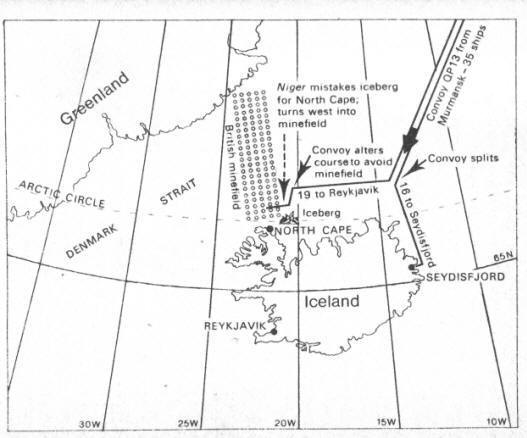
Iceland with 16 going to Loch Ewe and the other 19, escorted by NIGER,
Hussar a corvette and two trawlers, heading around the north coast of
Iceland to Reykjavik. |
|
|
Map source: 'Last Call for HMS
Edinburgh' Frank Pearce
|
|
|
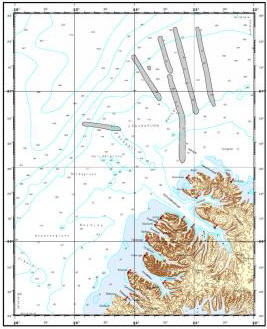
Actual location of mine barrage. During Operation SN, 110,000 mines
were laid both to the North East and South West of Iceland over three
years
Mines and Mine Laying in Iceland WWII |
|
5.7.42 |
At 1900 the convoy was
approaching the north-west coast if Iceland in five columns. The
weather was bad; visibility was under one mile, rough seas and a Force
8 wind from the north-east. No sighting had been taken since 2/7 and
the convoy's position, calculated by dead reckoning, was in doubt.
At 1910 NIGER's Senior
Officer (Commander Antony J Cubison) went on ahead in order to obtain a
navigational fix and suggested to the Commodore that the convoy be
reduced from five to two columns to pass between the coast at
Straumness and a British minefield to the north west of Iceland..
At 2100 NIGER, which had
gone ahead looking for land, leaving Hussar in between as a visual
link with the convoy, sighted what she believed to be the North Cape
and ordered a course alteration for the convoy. Unfortunately, what
NIGER had sighted was an iceberg and the alteration took the convoy
into the minefield. From soundings he estimated that the North Cape of
Iceland had been passed and ordered a south-west course to try to make
a landfall. Cautiously making his way through the mist and cloud he
suddenly saw what appeared to be a steep cliff looming up in the murk,
which he thought must be the North Cape after all. It seemed that the
convoy had altered course too soon and if they maintained the
direction they would be into the coastline. To correct this, Cubison
immediately signalled the convoy back on to a west course. Hardly had
the convoy swung back onto the new course when a clearance in the
weather showed that what had been taken for a cliff was in fact a
large iceberg.
Just before 2240 NIGER
realised the mistake and signalled the Commodore to change course but
it was too late and at 2240 NIGER hit a mine and blew up in position
66.55N, 22.20W. NIGER sank very quickly. With her bottom torn out and
her back broken she lasted but a few minutes. As she settled into the
Arctic sea there was a muffled roar as her boilers exploded. And then,
maintaining her level with the water, she slowly heeled over onto her
side, her mast and funnel dipping despairingly into a surface of
burning oil gushing from her tanks. For a moment the keel showed wet
black against the turbulent sea and then in a rush of vomiting bubbles
she was gone.
She took with her the
commanding officer, Commander Cubison, 80 officers and crew, and 39
passengers, survivors from HMS Edinburgh.
Fog further reduced visibility to 500 yards, and the Merchant Ships
thought a U Boat attack or Surface Raider attack was in progress. Four
Merchant Ships were sunk by mines, and two more seriously damaged.
The escorts displayed conspicuous gallantry in entering and remaining
in the minefield to rescue the survivors.
ROSLYS, whose Commanding Officer had appreciated that his ship was in
the minefield remained in it for six and a half hours while she
rescued 179 survivors.
Miraculously, two of the
passengers from Edinburgh survived NIGER's sinking. Finally a definite
shore fix was obtained by Hussar and the convoy reached Reykjavik on
7/7.
The Commanding Officer,
eight officers and 140 ratings perished when NIGER sank; the large
casualty list is probably explained by the fact that the ship was
carrying naval passengers home from North Russia including 39
survivors from HMS Edinburgh.
A letter dated September
from Tiny Peebles, the Petty Officer Gunners Mate on NIGER at the time
reveals that there were actually 8 survivors from NIGER of whom one
was a survivor from EDINBURGH. ADM 199/347 reports there
were 3 survivors from
NIGER
|
|
|
My father Lieutenant TB Johnston was on HMS Niger when she went
down off Iceland in 1942...
Two names which
were given by, I believe, the Admiralty to my Grandfather when he
was in correspondence with them shortly after the sinking ... are
Lieutenant P Wishaw RANVR and Sub Lieutenant O L Work RNR. The
letter states that these two survived the sinking.
Peter Johnston
Dec 2008
|
|